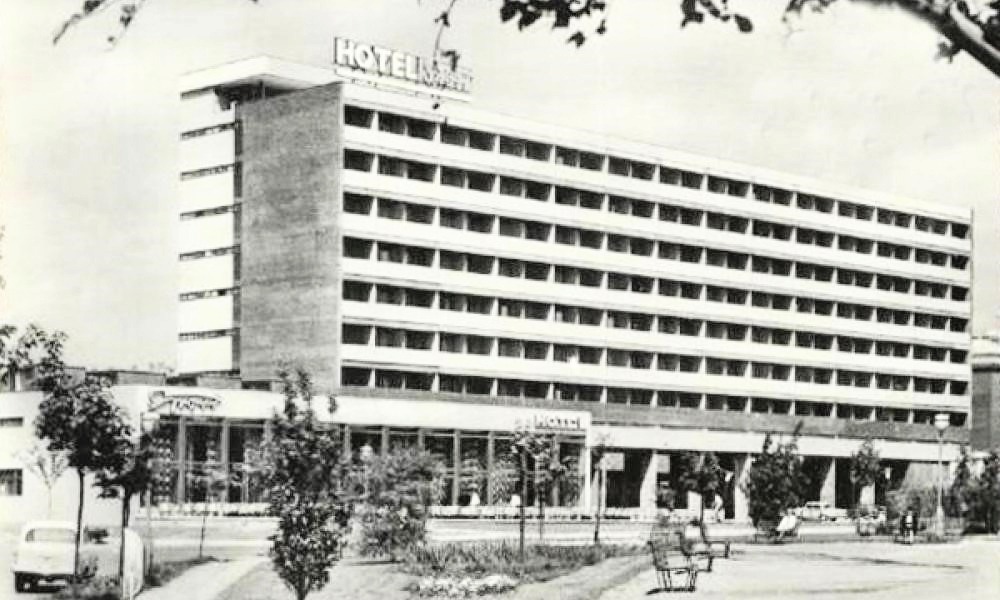
Hotel Sport and Culinary School Part 2
Sports still remained close to me. During this period, between the ages of 15 and 16, I was a water polo goalkeeper for two summers. The trainings took place at Csaszi Császár pool, today Császár-Komjádi pool. We played one-goal games, I was constantly trying to defend, but as soon as I threw the ball backward, someone would immediately shoot at the goal. By the end of the trainings, I could barely crawl out of the pool on all fours. Despite that, I really loved blocking the shots. The thought of becoming a field player never even crossed my mind.
For a day here and there, I swam and played football for clubs, but swimming was too monotonous for me, and with football, I faced the reality of how large the pitch actually was—about 100 meters long—so these sports only played a hobby role in my life. I also lifted weights for a very short time, but once a boy made me laugh while I was putting the 50 kg weight back on the rack on the bench press. At the time, I didn’t feel anything, but after a while, a lump appeared near my groin. It turned out I had a hernia, which had to be operated on. I also cycled, but just for leisure.
*
The three years spent at school were necessary to complement the practical experience gained at the workplace. My class teacher, Endre Takács, known as Uncle Bandi, was a good teacher and a good man who, knowing my family situation (I mean the loss of my father), looked at me a bit through that lens and guided me. During a home visit, they talked about me with my mother, who listened to Uncle Bandi’s report with relief.
Dr. János Almási, who taught commodity knowledge, was very strict. During oral exams, he would call out 5-6 students; he asked the first one a question, and before the child could even take a breath or make a sound, he would say, “You’re stupid, son, go back to your seat, fail!” This repeated with everyone. Of course, if the question concerned the Latin name of potato or vegetable marrow, then the answer solanum tuberosum or cucurbita pepo satisfied him. When I went to a national competition, a different commodity knowledge teacher was preparing me. She asked who my teacher was, how many fails I had, and finally declared that I didn’t need to attend the preparation sessions because she couldn’t teach me anything new.
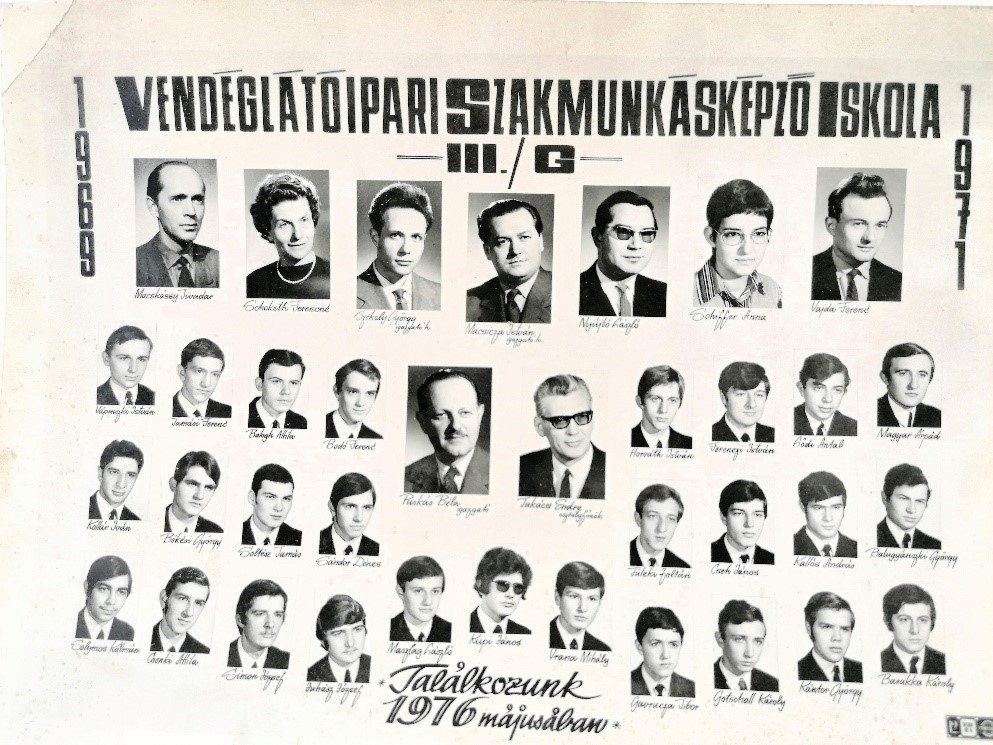
Third-Year Class Photo from Chef School
Among my classmates, I must mention György Békési, János Cseh, István Ferenczi, and Iván Kollár. All of them have worked their entire lives in the profession they studied, or in fields related to or utilizing that profession.
*
After the second school year, I had the opportunity to participate in a one-month summer internship in Bulgaria with several others. At 16 years old, despite the hard work, this trip was paradise itself. I was assigned together with my classmate Antal Lődi to a hotel on the Sunny Beach. The morning shift started at six o’clock, and by seven we had to finely chop 30 kg of onions. Towards the end of chopping, as the monotony increased, unfortunately the onions were cut increasingly larger. That’s when I managed to get used to the tearing effect the onions caused, so fortunately, I don’t have much trouble with that anymore. Afterwards, we had breakfast, then we had to knead large portions of the typical Bulgarian kebabchitsa and kufteta (which they called tyofteta to us), then form them into rolls or patty shapes. Following this, we had to prepare a similarly large amount of Shopska salad. After lunch, around three o’clock, the chef invited us into a separate room where the table was set and full of food and drinks. This was the staff lunch. The chef, patting us on the back in a friendly manner, offered us cold beer. The hotel was full of several hundred foreign guests, most of whom used the restaurant both at noon and in the evening.
After two weeks, at another modern large hotel, during the afternoon shift, we were often fully responsible for the so-called “skara placc” (meshana skara), which meant the grill station. Then in the afternoon, we prepared the aforementioned meats and additional skewers and meat slices, either made by us or supplied ready-made, and also mixed about 300 portions of Shopska salad, each garnished with a carved tomato rose. During dinner, the two of us grilled all the ordered meats and served the salads. The Bulgarian kitchen staff prepared and served about 20-30 other dishes, while the two of us served more than 300 portions of grilled food, with the chef helping us by frying French fries to accompany our dishes.
When we weren’t working, after work if possible, we met up with the others, so about fifteen of us gathered at the beach and had a good time. Our accommodation was in Nesebar, which is a gem of a town where we walked to rest and relax.
*
I completed the national competition for the cooking school a few months before the end of the school year, in March 1971, in Sopron, at the local vocational school and the Fenyves Hotel. At the hotel, the staff was extremely busy at the time, so due to lack of space, I had to prepare the compulsory exam element—the decorative platter—in the vegetable prep room, by the dishwasher. On top of that, the floor drain was clogged and the room was flooded with water. Of course, by then I was already equipped with the mindset that I had to somehow solve any difficult situation. Standing on two upside-down big pan, I served the composition, which was a violin-key shaped arrangement of fried veal chops, the rib bones cleaned white, the meat coated with cold Madeira sauce, garnished with blanched and sautéed chicken liver, tournéed button mushrooms, and truffle, and accompanied by vegetable side dishes.
Although I did not win a medal at the competition, based on the points I earned, I successfully passed both the theoretical and practical exams, and from then on I proudly wore the title of cook at my then workplace, the Sport Hotel. Not to mention, instead of the starting salary of 1250 Ft, in recognition of my results, I received 1400 Ft. From this time, still just 16 years old, I officially became the breadwinner of the family—that is, I supported my mother—who was constantly ill and received only a few hundred forints per month—and myself.
*
I worked as a qualified cook at the hotel for the next three years. Besides working and taking care of my mother, I went to music venues to dance, socialize, and have fun. In the autumn of 1973, I made a big decision: I thought we needed more money to ensure my mother’s secure care, so I wanted to go to Switzerland to work. At that time, this could only have been done by illegal border crossing, so I went on a “trip” to Yugoslavia for a few days.
I tried to cross the border twice—first in Gorizia toward Italy, then in the north toward Austria. Neither attempt succeeded. In the first case, they noticed me at the train station, interrogated me, and then let me go. After that, I headed to Ljubljana, where I met a young Swiss man. I told him my plan and motivation. He proved helpful, so we agreed that in the evening he would take me by car near the border, where I would jump out and cross the green border on foot, and then we would meet later on the road in Austria. The last settlement was Podkoren; he drove me a little further, then, as planned, I got out and started toward the dark forest to the north, and at the same time the border. The terrain was terribly steep, I climbed up, but after a while, completely exhausted, I gave up. I couldn’t find the expected road. I was freezing completely; it was very cold. At dawn, I headed back. I couldn’t feel my fingers; they were almost frozen. On the way, since I had no water, I sucked on icicles near the Podkoren border.
I returned to Hungary and my workplace a few days past my original vacation. The director was already waiting for me, knowing about the Gorizia incident. From that point on, I didn’t feel very comfortable at work, and probably for this reason, the following summer I was already working at Lake Balaton.
*

Click on the image to watch the “Roast rabbit loin fillet” video made at the Joyful cooking event!
You can find the recipe below the video!
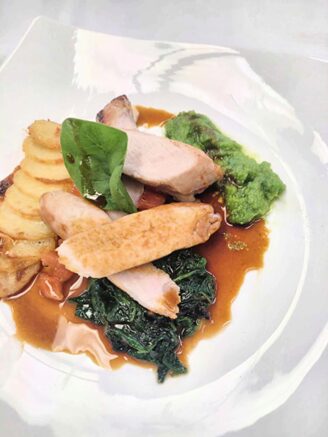
Roast rabbit loin fillet with pea purée, spinach leaves, creamy potato slices, white wine tomato concassé, and bacon chips
Recommended ingredients for 4 servings:
for the rabbit loin:
600 g rabbit loin fillet
salt
40 ml olive oil
40 g butter
for the potato slices:
300 g potato
salt, nutmeg
80 ml cream
for the green pea purée:
300 g green peas
40 g butter
parsley
salt, nutmeg
for the spinach leaves:
400 g baby spinach leaves
40 g butter
salt, mixed pepper (optional)
for the tomato concassé:
400 g meaty tomatoes
40 g butter
salt, mixed pepper, rosemary
100 ml dry white wine
for the bacon chips:
40 g bacon
Here are the preparation steps:
Remove the membrane from the rabbit fillet, shape the ends, place the meat in the refrigerator, and make a jus (gravy) from the remaining parts.
To make the jus, dry fry the small meat pieces in a pan, then continue frying with diced yellow and parsley root, celery, and leek. Add tomato purée and cook for a while, then pour in water and red wine. Season with bay leaf and thyme, and bring the whole mixture to a boil.
Wash and peel the potatoes, then slice them thinly (2-3 mm thick).
Gently mix the sliced potatoes in a bowl together with the other ingredients.
In a baking tray, arrange the potato slices overlapping by half, making several layers. Bake at 150°C (302°F) for about 30 minutes. Finally, brown the top in a hot oven.
Braise the peas in butter with a little water, salt, grated nutmeg, and parsley, then puree them and strain through a fine metal sieve.
Blanch the tomatoes, remove skin and seeds, then dice.
Place the bacon between two sheets of baking paper on a tray, press it down, and bake at 200°C (392°F) until crispy.
Sear the salted rabbit fillet in a hot pan with a little olive oil, then continue cooking while spooning melted butter over it. Let the meat rest afterward.
In the remaining fat, sauté the tomatoes, add the jus, season with salt, freshly ground pepper, and rosemary. Pour in white wine and stir in cold butter.
Quickly sauté the baby spinach in butter with crushed garlic and season with salt.
To serve, place the diagonally sliced rabbit fillet on the tomato ragout, arrange the potatoes, pea purée, and spinach beside it. Drizzle with the jus, garnish with green leaves, and finally, if you don’t forget :), sprinkle the crispy bacon over the meat.
Preview
1970s.
Joyful Cooking with Ferenc Balatoni, who was my head chef in 1976 at Pilvax.
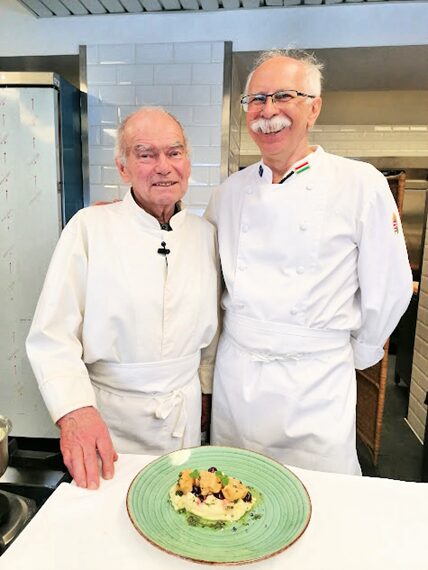
With Balatoni Ferenc
*