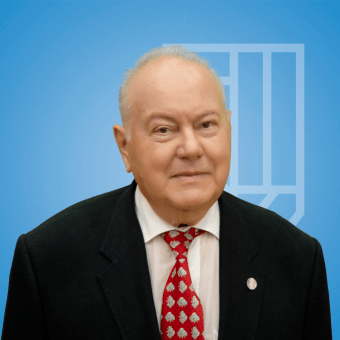
Prof. Em. Dr. Dr.h.c. Gundel János
I was born on October 1, 1941, in Budapest, into a family working in the hospitality industry. I completed my primary and secondary education in Budapest, graduating in 1959 (Kölcsey Ferenc High School), and in the same year, I was admitted to the Mosonmagyaróvár Agricultural Academy (as it was called at the time). In 1963, I earned my degree in agricultural engineering. I wrote and defended my thesis titled “The Animal Pests of Tomatoes, with Special Attention to Control of the Spider Mite (Tetranychus telarius L.),” which at that time substituted for the final state examination.
In 1991, after defending my dissertation “Investigation of Factors Influencing Nutrient Uptake in Pig Fattening,” I received the scientific degree of Candidate of Agricultural Sciences from the Scientific Qualification Committee of the Hungarian Academy of Sciences (MTA), and based on this, I obtained a university doctoral title at the Mosonmagyaróvár faculty. In 1996, I habilitated at the same institution, delivering lectures titled “Industrial Compound Feed Production” and “Conservation and Use of Moist Conserved Corn in Pig Feeding.”
My first workplace was in Kecskemét at the experimental unit of the Danube-Tisza Agricultural Research Institute, where I worked as a brigade agronomist. In 1966, I joined the National Feed Quality and Control Authority, initially as an inspector, then in the development department working on pig feed formulations. During this time, I became acquainted with chemical feed analysis and slaughterhouse grading of animals. In 1967, following a higher-level reorganization order, I moved to the Animal Breeding Research Institute’s Feeding Department. My work expanded to scientific research tasks (monogastric animal protein and amino acid nutrition and related animal experimental and chemical-analytical work), and as a lecturer, I began teaching (primarily postgraduate) in higher education. During this period, I started exploring the applicability of computers in feed research and practice.
Important results from our research group in the 1970s include solutions for early weaning of piglets (21–28 days), development of feed recipes based on grains + vegetable protein + synthetic amino acids, introduction of feed mixes designed with linear optimization (first in Hungary), and experimental and laboratory testing of new cereal varieties (triticale, corn, sorghum, etc.) and other new or innovative feed materials. Subsequent significant achievements include developing a new pig feed energy evaluation system, fermentation preservation of high-moisture corn (corn kernels, CCM, CSM), and developing semi- or fully automated feeding technologies for “liquid” feed made from slaughterhouse by-products for pig fattening, usually in collaboration with colleagues. Other key research includes studying the effects of recombinant porcine somatotropin (rPST), determining the feed value of full-fat soy, evaluating the effects of heat treatment on potential pig feeds, the applicability of saponin-free alfalfa, and reviewing the nitrogen and phosphorus content of feeds to reduce environmental impact. To enhance the quality of research, I regularly focused on improving research methods, the institute library, and computing infrastructure. In the final phase of my research career, I focused on how animal nutrition could influence the quality of animal products (mainly pork, broilers, and turkey), particularly meat, in terms of human nutrition (opportunities for producing functional foods). My latest research addresses how food quality changes with various culinary techniques, and I also study the history of domestic and international gastronomy, including interpreting dietary rules in different religions (e.g., bread and salt in the Bible, or kosher food practices).
At the Institute of Animal Husbandry and Nutrition (and its legal predecessors/successors), in addition to scientific organization tasks, I had other administrative responsibilities, including overseeing workplace safety for around twenty years. In the 1970s, as a deputy head (for a time chief deputy) of the Feeding (Main) Department, I participated in managing the department’s work. From its founding in 1980, the Pig Feeding Department was directly under my supervision. From December 1985, I served as director, responsible for the operation and scientific work of the Institute of Feeding. Following an internal reorganization in 1986, I was tasked with managing all facilities in Herceghalom, including the experimental farm, slaughterhouse, feed mill, maintenance, and renovations. After the 1991 reorganization, as Director of the Institute of Feeding, I oversaw the scientific work of the entire institute, ensured conditions for research, and directly supervised the Pig Feeding Department. For many years, I chaired the scientific committee overseeing the experimental farm. During the 2003 reorganization, I became deputy scientific director, serving until September 30, 2006 (upon reaching the age of 65), after which I continued as a scientific advisor.
Between 1996 and 2007, at the Faculty of Agricultural and Food Sciences (DATE MTK, now DE AC), I was responsible for teaching feed science, where I organized the country’s first specialist program for compound feed production engineers. Since the early 2000s, I have taught a course for PhD students titled “How to Give a Scientific Presentation and Write a Scientific Paper.” From February 1, 2008, I taught at the Budapest Business School (since January 2016, University), Faculty of Commerce, Hospitality and Tourism, first as a faculty member and later as head of department, until June 30, 2013. I currently continue teaching as a visiting emeritus professor. My BA courses include Food Science, Hospitality History (both also in English), Gastronomic Basics, and Specialty Foods and Beverages, while at the MA level I teach Theory and Practice of Gastronomy and Health (full-time, distance, and correspondence). Between 2013 and 2019, I also taught at the Sapientia University Faculty of Food Engineering in Csíkszereda and at the Semmelweis University Faculty of Health Sciences (2014–2019), covering gastronomic subjects, including historical cuisines.
I have supervised numerous theses and dissertations as an internal and external consultant at various higher education institutions. I am regularly invited to review BA/Master/PhD theses (5–10 per year recently, some in English). I previously supervised two foreign aspirants, and five of my students have successfully defended their PhD dissertations. I have repeatedly served as opponent for candidate or PhD theses and as a member of committees reviewing habilitations.
My scientific work has been recognized with multiple institutional and state awards: MTA recognition in 1983, special award from MÉM in 1985, appointment as university private lecturer at the University of Debrecen in 1996, honorary doctor (Dr.h.c.) in 1999, a university medal in 2009 for “outstanding teaching and research over many years,” a shared MTA Academic Award in 1999, and Széchenyi Professorial Fellowship from 2000–2003. In 2005, I received the Tangl Ferenc Award from the Hungarian Society for Nutrition for my work promoting collaboration in human and animal nutrition. In 2013, I was granted Professor Emeritus by Budapest Business School. In 2016, for preserving and fostering the ancient Óvár traditions, I received the Wittmann Antal Award from the Óvári Farmers’ Association. In 2019, the Hungarian Association of Naturopathic Practitioners awarded me the “For Naturopathy” prize for outstanding research, teaching, lecturing, and writing in gastronomy, dietetics, and nutrition science.
Since the early 1970s, I have been a member of various permanent and ad hoc committees of MÉM/FM/FVM/VM, MTA, and OMFB. I was first a consultative member, then from 1993 a regular member and secretary of the MTA Committee on Animal Breeding, Husbandry, and Feeding. From 2001, for two terms, I participated in the MTA General Assembly and the Agricultural Sciences Division as an elected representative. I have regularly served as expert/reviewer for various ministries, former OMFB, OTKA, NKHT, and other grant programs. I was a member of the Hungarian Feed Code Committee for years and remain a member of two committees of MÉBIH and the VM “Traditions, Flavors, Regions” review committee.
Internationally, from 1972–1989, I was the lead coordinator of a multinational (COMECON) research group representing research institutes from seven countries. In 1988, I was elected secretary of the European Association for Animal Production (EAAP) Feed Section, serving until 1995.
I have been a frequent invited speaker at domestic and international scientific conferences and other events, as well as at various higher education institutions. To date, I have delivered over 650 scientific and popular science presentations, approximately 150 in foreign languages.
Regarding publications, I have co-authored 15 books (three awarded publishing prizes) and published over 350 articles, some in foreign journals. I am aware of over 100 domestic and international citations to 62 of my papers. Five patents co-authored by me have been granted.
Besides conferences and professional sessions abroad, I have studied education and research in other countries, as well as research-consultancy-continuing education systems, often as a scholar. Particularly notable were visits to universities and research institutes in Austria, Germany, France, England, Italy, China, Egypt, Australia, Japan, and the USA, beyond former socialist countries.
Since 1980, I have been involved in editing the scientific journal Állattenyésztés és Takarmányozás, serving as editor-in-chief from 1989–2008, and subsequently as advisor. I was a member of the editorial board of Tejgazdaság and the Egyptian Journal of Nutrition and Feeds International Scientific Committee. From 1999–2006, I participated in the Livestock Production Science Editorial Advisory Board.
Beyond scientific work, I have actively participated in organizing scientific events for my workplaces, the MAE, MÉM/FM/FVM/VM, MTA, and other institutions. Notable events include the 6th International Symposium on Amino Acid (1978, 250 foreign participants), Feed Additive Symposium (1981, 300 foreign participants), and the European Association for Animal Production Congresses of 1986 and 2001 (1,500 foreign participants each), where I served as operational head of the organizing committees.