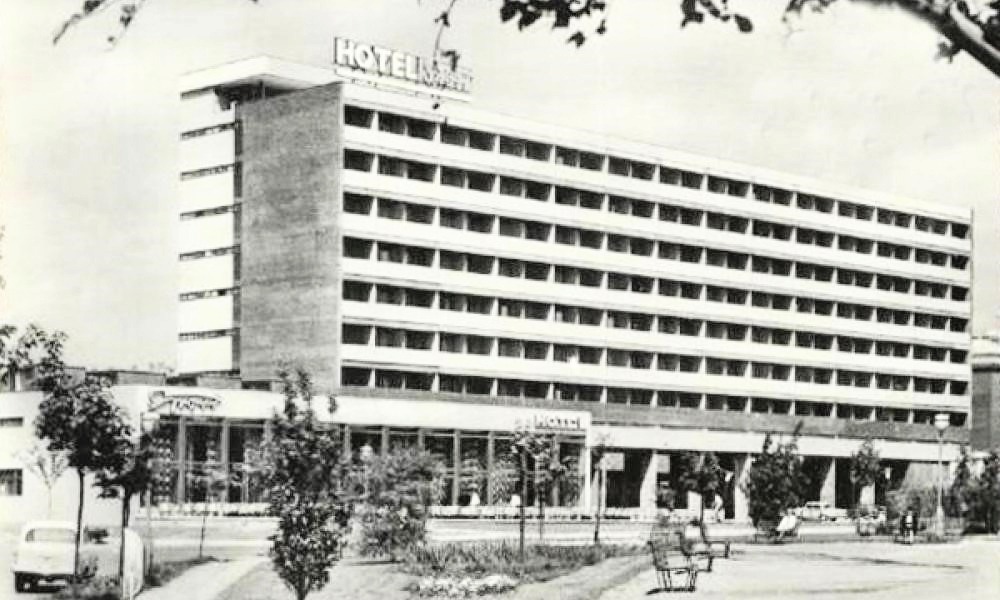
Hotel Sport and Culinary School
Part 1
In early September 1968, when I was 14 years old, I began learning the chef’s trade. According to the weekly schedule, I attended school two days a week and had to work eight hours a day for four days at my workplace. My first day at work immediately became defining for my future professional career for several reasons.
My first impression was about how to properly greet people. I had to be at work by 7:30 in the morning, and I arrived on time around 7:15, dressed in my chef’s uniform, and appeared in front of the chef’s booth where Mr. Miklós Juhász, the head chef, was. I greeted him timidly with a “csókolom” (a polite, somewhat formal greeting akin to “I kiss your hand”), to which he loudly responded, “What’s this ‘csókolom’? Maybe ‘Good morning’ would be more appropriate!” Clearly, this left a mark on me, as I still remember it 57 years later.
The next defining experience that same day was processing sixty kilograms of crayfish from Zala, together with three fellow first-year apprentices. We were shown how to grab the wriggling animal so that its claws wouldn’t pinch our hands, how to scrub its belly with a nail brush under running cold water, and to discard any dead ones. The live ones were then cooked in a prepared broth of salted water with caraway seeds and parsley, cooled down, and broken down. During the disassembly of such a large quantity — three aluminum trays used for storing and transporting meat — the hard chitin shells cut our hands all over. My hands ached for days afterwards, but my poor classmate Péter Mózes told me decades later that the skin on his hands was torn up for two weeks. The digestive tract had to be removed from the tails, they had to be rinsed again, and then we packed the claws and tails into cellophane bags in individual portions. Finally, the portions were placed in the freezer. The shells had to be crushed in a porcelain mortar and used to make crayfish butter.
Ten minutes after 4 p.m., I went to the chef and asked, “Chef, may I go home?” to which he replied, “What’s the rush?” So I returned to the kitchen to continue working. Lucky for me, because that’s when I was shown the snails stored in the cold room, starved for several days. At that moment, they were happily munching on parsley, not knowing — unlike me — that the next day, they would be processed. After 6 p.m., I returned to the chef again with the same question, and this time he said, “If you’re in such a hurry, then go,” in a resigned tone. He probably thought I was hopeless — after about 11 hours of work, on my first day at age 14, I already wanted to go home.
On the second workday, it was indeed time to process the snails. After thorough washing, they were soaked in plenty of vinegar water for a while. Any that floated were discarded. The rest were briefly boiled, rinsed with cold water, and then simmered in a seasoned broth until tender. After draining and cooling, we used a meat pin to extract them from their shells. The skin and dark parts had to be trimmed off and disposed of. The boiled snail meat was portioned into cellophane bags in sets of 12 and then frozen. The shells had to be washed, soaked in baking soda water, strained, and dried. We later used these cleaned shells multiple times for preparing and serving snail dishes.
On the third workday, it was time to process frog legs, which turned out to be a kind of “cool-down workout” compared to crayfish. The frog legs were rinsed with cold water, unusable parts cut off and discarded, the paired legs dried, then one leg tip was threaded through the meat and bone of the opposite leg. Then came the now-familiar portioning into cellophane bags and freezing. At the end of this day, I pondered where I had ended up — crayfish, snails, frogs… Later I realized that life had steered me in a very good direction after all. At that time, the Hotel Sport kitchen represented one of the highest standards in all of Hungary, thanks to head chef Miklós Juhász and his kitchen team.
Miklós Juhász was held in high esteem by his direct colleagues, former coworkers, apprentices, other head chefs, and also by his superior, Director Mrs. Sándorné Gácsi. His immediate colleagues respected him greatly for his vast knowledge and his almost always justified criticisms. They believed that the “old man” — referring to his age, around seventy — was still right 90% of the time. As a singular example, he often mentioned his former apprentice, Egon Eigen (himself a culinary icon), with pride. On one occasion, the hotel director pointed out that chef György Hegyi had been drinking — he was, in fact, working under the influence at that moment — to which Chef Juhász, in his gruff voice, replied: “Excuse me, Mr. Hegyi does not drink.” That effectively ended the discussion.
Chef Juhász was a classical chef — he kept tight control over the kitchen, worked from morning to evening, and led by example through his expertise and humanity. He did administrative work in the chef’s office, inspected in the kitchen, and voiced his disapproval in a firm tone when he encountered substandard work. He would erupt especially loudly after poor inventory results. Then he would emerge from the chef’s booth and stride through the kitchen shouting: “What is this, a gang of thieves or a gypsy caravan?” On one such occasion, after he had scolded everyone, it turned out the inventory had been taken incorrectly — four large containers of Strasbourg goose liver pâté had been forgotten in the cold room. Even then, they were worth a fortune.
Chef Juhász had a private pantry into which only he was allowed and where he kept premium ingredients. These included truffles in cognac, olives, capers, canned white asparagus, secret spice blends (one for pâté), and various alcoholic beverages: sherry, port, Madeira wine, cooking wines, cognacs, rum, etc. Cooking wine, usually selected Riesling, was more than an ingredient — it was a part of his daily routine, as he sipped a bottle (1 liter) each day.
He rarely took part in everyday cooking but would improvise a dish if he had a guest. He would step behind the plating counter on the kitchen side and give orders while preparing a new creation in a pan. Commands flew around:
“Boy!”
“Give me that pan!”
“Mr. Imre” (the butcher)!
“Give me two portions of pike-perch fillet! No bones!”
“Mr. Hegyi!”
“Cook the fish à la Meunière!”
“Boy!”
“Bring a pack of crayfish claws from the freezer!”
“Bar!”
“I need 2 centiliters of cognac and half a deciliter of dry white wine!”
“Boy!”
“Bring a deciliter of cream!”
The dish would be completed. He’d call over his sous-chef and Mr. Hegyi to taste the sauce from the pan with a spoon, and as they praised it to the skies, he would say: “Gentlemen, this is how a dish should look.” A few days later, learning from Mr. Juhász, the sous-chef began ordering cognac and white wine from the bar for a dish, to which Chef Juhász, present at the time, asked: “Why are you adding cognac and wine to that dish?” The sous-chef replied: “Well, you added it the other day.” To which he calmly said: “No, that dish doesn’t require it.” As the classic György Sándor joke goes: “Equal tracks, equal chances — but I’m riding a bicycle.”
At the time, we were strictly required to make Hollandaise sauce with cream. On one occasion, a newly arrived young, athletic chef named István Juhász was seen running from the chef’s booth to the far end of the kitchen, with Chef Miklós Juhász shouting behind him: “Hollandaise sauce is made with cream!” We later learned that Pista had suggested to the chef that the sauce be made with a mix of half cream and half water.
There were two developments to this story. First, István Juhász later became deputy head chef, then head chef of the Budapest Hilton, where he retired after thirty years. Second, in international gastronomy, Hollandaise sauce exists in several variations, and fundamentally it is not made with cream but typically with a water-based reduction. Of course, egg yolks and butter — as the essential emulsion ingredients — are always part of the sauce.
I have many personal memories of Chef Juhász. Regarding the unquestionable nature of his professional knowledge, I was once involved in a situation where my form teacher and vocational instructor, Endre Takács, said during a sauce lesson that blood orange is not included in Maltese sauce. However, in the hotel kitchen, there was a short description of dish variants which listed blood orange as an ingredient in Maltese sauce. Wanting to clarify, I asked “Uncle Bandi” who was correct. A few days later, my teacher told me to inform Mr. Juhász that he was right: blood orange is in Maltese sauce.
The next day I told the chef, who replied: “Yes, I’m always right.”
The first time he praised me was in my second year as an apprentice, and even that happened accidentally. Before service, he was tasting the hot dishes, including the mashed potatoes that day. He dipped a finger into the mash, tasted it, and in his unforgettable voice asked:
“Who made this mashed potato?”
Nervously, expecting a scolding, I replied softly:
“I did, Chef.”
To which he responded:
“Finally, some decent work from you!”
When I was making pancakes at the stove — where six pans fit side-by-side — I was very fast. I poured a little oil into each pan. In the first, I poured the batter and swirled it so the dough reached every edge. Then I repeated the same for the other five. By the time I poured the sixth, the first needed flipping — which I did by tossing it in the air. Once the first was done, I slid it onto a plate, re-oiled the pan if necessary, added batter, and continued the process with the next pans. One time I got bold and put twelve pans on the stove. I started running back and forth across the stove, literally, to make pancakes. Suddenly, Chef Juhász appeared and asked:
“What are you doing here?”
“Making pancakes, Chef.”
“Take those pans off right now — even I can’t cook with that many at once!”
It was a great honor when I was allowed to make his breakfast scrambled eggs.
He liked it soft, cooked in butter. New Year’s Eves were also memorable. After midnight, when we apprentices returned from walking the live piglet among the guests — where they pulled its tail for luck in exchange for money we collected in a champagne bucket — we would stop for a moment at the chef’s word. His face softened, and in a warm voice, he thanked everyone for their work over the past year.
One of the notorious sous chefs was György T., nicknamed “Kopasz” (The Bald). His favorite spot was the stool behind the oven, where he would sit and lean his back against the warm oven. The most affectionate way he addressed the apprentices was: “Come here and rot!” From that, even those who didn’t know him can imagine the character of this man. Occasionally, he also beat the apprentices. Poor Péter Mózes, who at 14 already weighed around 100 kg, got such a hard slap on the back that he nearly fell into the 90-liter pot of boiling broth. Laci Kovács, a third-year apprentice cook, was cornered between the cooler and the wall in the meat prep room, then beaten with frozen tenderloin. Poor “Mazsola,” that was Laci’s nickname, shouted begging: “Don’t hurt me, Chef!” Perhaps the worst was when József Parti, a young assistant/cook, was chased by T. György into the fish prep room aquarium, where live carp were swimming. He shouted at Józsi:
− Get in!
− No, Chef!
− Get in!
Finally, Józsi, who was bigger and stronger than T. György, got into the aquarium and stood there, humiliated among the fish in his white chef pants.
I consider myself lucky because, although Mr. T. addressed me with “kind” words during my apprentice years, fortunately, I was spared physical punishment. Of course, others also showed their superiority, like Csaba Cs., who was a young assistant/cook himself, about 18 years old, and when I, at 14, asked him something, he corrected me: “Not Csaba, Csaba sir!” From then on, I used formal address. A year later, he invited me to help at a pig slaughter. He offered me a drink in the morning; we toasted, but it took some time before I could say: − hi Csaba. The irony of life is that once the paprika sauce Csaba made was too thin, and the often “praised” Mr. T. yelled at him, then turned to me and said: − Dénes, fix the paprika sauce! While I was making the sauce as an apprentice, Csaba’s haughtiness came to my mind.
*
It should be added that already as a second-year apprentice I was given the task of training incoming first-year apprentices, which was a very honorable duty. My favorite apprentice — though unofficially, because an apprentice cannot have an apprentice — was Csaba Horváth, who called me Déni. I tried to thoroughly show him everything, and he was enthusiastic, as he should be, and as a basic requirement. Years later, Csaba worked at the Budapest Hilton, running the kitchen of the Coffee Shop restaurant — at that time we reconnected professionally because I was doing my college summer internship there in 1978 — and later he served as the head chef of the entire kitchen, from which he retired.
Earlier, Hegyi György was mentioned, who was well known for his fondness for drinks. At the same time, his professional encyclopedic knowledge and intelligence were outstanding. When there was a “situation” in the kitchen—that is, an almost unsolvable scenario arose, which is quite common even in a well-functioning kitchen—he would quote Saint John Chrysostom, the bishop of Constantinople, who said: “There is no trouble as long as there is no trouble.” A small digression about his refined taste: when we talked about various kinds of music, he revealed that he truly loved good jazz music. As fate would have it, at that time the world-famous jazz pianist Oscar Peterson visited our country. We went to his concert at the Erkel Theatre. His virtuoso performance was a lasting experience. Returning to the kitchen, Mr. Hegyi tried to protect his body from alcohol by drinking in the morning a soup bowl of lemon juice and cooking oil, which he often made me. He drank it in a way that visibly he did not swallow. It was even hard to watch. Afterwards, he drank various kinds of drinks. Sometimes he would walk over to the pub and when he returned he was visibly cheerful. Meanwhile, he loudly sang various rhymes such as: “Yellowhammer swallow’s nest, Gyuri Hegyi is drunk again,” or “The city is full, the city is full of Soviet soldiers.” I asked him what he drank in the pub, and he said the bartender mixed various drinks into a long drink glass, which he drank on the way back to the kitchen. It is not recommended to try the mixture of pure alcohol and tea, which he also regularly sipped. One of his flashy tricks was preparing a large pot with a smaller pot inside in the black sink. He placed the pots in the chef’s line of sight, then loudly so Mr. Juhász would hear: “Chef! The wine is going into the brown sauce, we won’t drink it!” While dramatically pouring the red wine from a height into the small pot inside the big pot. Unfortunately, Mr. Hegyi’s story doesn’t have a happy ending because he passed away young, in his thirties, going to the eternal hunting grounds.
István Kammayer, a cook, also died young. He was known for chopping objects at hand on the floor when he was nervous or upset, whether it was a pot or a knife. When he was calm, there was no problem with him. Once he was standing on the kitchen side of the serving counter and needed a restaurant dish stored on the other side of the serving counter. Seeing no one there, he shouted out hoping a waiter might hear: “W*ores give me a single-person casserole dish!” Then a young waitress’s voice answered: “I’m giving it.”
Three cooks named László Varga also worked in the kitchen. The “poor” Varga Laci was very friendly and approachable. The nickname “poor” was given by Gábor Kis because when Gábor asked Laci for a 20 fillér loan, Laci turned out his pockets, which contained only 10 fillér in total. Then Gábor said: “You’re a poor guy, man.” Varga Laci specifically asked me to use informal address and you could approach him with any question or request. When he announced to the chef that in a few weeks, on Saturday, he would have his wedding and asked for a day off, Mr. Juhász started to rise from his chair in the chef’s line and loudly shouted: “You, Laci! How dare you have your wedding on a Saturday during the peak season! Move it to Thursday!” To which Laci replied: “Yes, Chef.” It should be noted that at that time it was probably February, which is hardly a busy season.
Varga Laci told a cute story about his father and Mr. Juhász. His father was a gentleman’s tailor to whom the chef went to have a winter coat made. As mentioned, the chef was about 70 years old at the time. The tailor asked the chef what kind of coat he wanted. The chef replied that he wanted the coat made of the best possible, durable English fabric. To which the tailor said: “But Mr. Juhász, for such a short time?”
Without aiming for completeness, among the cooks, Gyula Tóth and Ferenc Ácsbold must be mentioned, with whom I worked together in the summer of 1974 at Lake Balaton. Gábor Kis, with whom one winter, around midnight after an afternoon shift, we were walking home together. The temperatures were well below zero, and on Mártírok útja (Margit Boulevard), we noticed a tapping sound on the deserted street, as if someone was following us. But we soon realized that the sound came from my long hair, wet from the shower and frozen, knocking against my coat. Gábor later stayed at the Flamenco Hotel and retired from there. Zsigmond Szabó, who spoke excellent German and English and with whom I was also very good friends outside of work. On one occasion, we were at the Csillaghegy open-air pool with Zsiga, and upon seeing a pretty girl, he remarked: “I’d like to spend some time between your legs.” This caused huge laughter from the British young men who were also admiring the girl. Fortunately, the girl continued walking with a resigned expression; she was probably only physically present. Later, Zsiga transferred to the Hotel Duna Intercontinental Bellevue restaurant, where as a flambé chef, he was able to excellently use his foreign language skills.
What was the organization and daily workflow like in the kitchen?
We worked in two shifts, in brigades, from 7:30 to 15:30 and from 15:30 to 23:30, but as I mentioned earlier, especially for the apprentices, it was expected to start earlier and finish later. In the morning shift, there were more of us working: the chef, a sous-chef, about three to four cooks, one in the cold kitchen/larder, two or three apprentices, a kitchen butcher (mészáros), and two cooking women (Mutters). They prepared the staff meals, restaurant pasta, and part of the soups, side dishes, and stews. Two or three handmaidens (all-purpose ladies) started early in the vegetable prep area, preparing daily vegetables based on the lists given by the cooks — for example, carrots, parsnips, celery, cabbage, etc. for the broth. They peeled potatoes using machines and knives and cut diced potatoes for the mashed potatoes, but more refined cuts — like straw or diced potatoes — had to be done by the apprentices. These women later helped in the kitchen with cleaning. One blackwasher was responsible for washing kitchen utensils.
The kitchen butcher came earlier than the cooks and by the time they arrived, he was done with boning, cleaning, and cutting meat parts, for example, pork legs, and then continued his work based on the list given by the cooks. The itinerary looked something like this: 5 kg pork shoulder cut into cubes for stew, a pork belly skewered for stuffing, 2 kg pork liver cut into strips for fried liver, etc. He also sliced the meats needed by the various groups. Often the apprentices had to help him with tenderizing (pounding), as that was their task. One could learn a lot from Uncle Imre, the kitchen butcher. He showed everything — from knife sharpening and honing, to boning, cleaning, cutting, slicing, marinating, pounding, or even fish processing. With professional movements, he demonstrated knife usage while saying, “I’m pulling that knife.” That’s how you could bone or slice quickly and without damage. Of course, saying it is easy, but doing it is much harder. If anyone worked even faster than Uncle Imre, it was Uncle Gyuri Lusztig, another kitchen butcher — they worked in shifts. He came to work at half past six in the morning, and by half past seven, when the cooks arrived, he was often done with everything. Antal Fehér was also a kitchen butcher a few years later. In the mornings, he would tell me he had cut a pork tenderloin into strips to prepare a little breakfast that could be dipped in fresh bread. I would quickly heat some fat, fry the meat, then take it out, make a stew base with paprika in the fat, put the meat back in, and voilà — a tender and tasty delicacy was ready. We two would gobble it up with fresh bread and leavened cucumbers (of course peeled). When Tóni — a well-built man — was in a bad mood, for example after a Ferencváros (Fradi) defeat, he would casually toss the butcher’s cleaver through the pass-through window (luckily open) from the meat prep area into the kitchen.
In the afternoon shift, fewer people worked because most of the cooking was done in the morning.
*
The breakfast hot egg dishes (except for the soft-boiled eggs, which were prepared by the coffee kitchen) were made by the hot kitchen, and these tasks were always entrusted to a suitable apprentice. The shift started at six o’clock in the morning, and by seven, everything had to be ready for serving breakfast, after which the orders started arriving. Various types of omelettes—cheese, ham, mushroom, etc.—as well as ham and eggs, bacon and eggs, and so forth had to be freshly prepared to order. The ham and eggs had to be cooked in a single-serving buttered ceramic baking dish, with a slice of ham and eggs cracked on top, then fried on the stove’s hotplate. Some guests even requested an inverted ham and eggs. In this case, the cooking started in a frying pan, and then the whole was flipped “upside down” and cooked further. The process was similar for bacon and eggs, except that the bacon slices had to be pre-cooked in a pan before being either transferred to a ceramic dish or left in the pan, onto which the eggs were then added.
The work was optimized (though not called that at the time), so besides the breakfast tasks, the apprentice had to perform many other duties, such as making pancakes, finely chopping parsley, cutting straw potatoes, slicing Lyonnaise onions, and so on. The requirement for the chopped parsley’s fineness was that it should be as fine “as flea dork on a pimple.”
Breakfast was served between 7 and 10 a.m., with these additional tasks sometimes stretching past 10 depending on the workload, as naturally, the priority was the preparation of à la carte breakfast orders. Afterward, the serving table had to be wiped down, covered with a clean white tablecloth, a cutting board placed on it, and the so-called “patika” had to be prepared. This “patika” included melted butter and crayfish butter, finely chopped parsley, mixed sour cream, and “pofazsír” (which is a fatty part of paprika sauce; back then, dishes covered with paprika sauce—like the Hortobágyi pancake—were garnished with sour cream and pofazsír, and sprinkled with finely chopped parsley). Incidentally, this now obsolete method—which I myself criticized about 25 years ago during a kitchen expert consultation—shows the relationship between the fundamental ingredients of the dish (paprika sauce and sour cream in the Hortobágyi pancake) and its decoration. Moreover, the red, white, and green tri-color decoration also had a symbolic meaning. The serving table also held sprigs of curly parsley in ice water, lettuce leaves in bowls, chopped tomatoes, and green peppers. Spare kitchen towels, paper napkins, and soup spoons placed in a soup pot filled with water were also prepared. Even non-professionals could see from this that the “patika” meant the set of elements used at the time for presenting dishes.
The apprentices were basically all-rounders, because at the same time they got instructions from several cooks:
− Bring a small mixing bowl and a whisk (in Mr. Hegyi’s manner of speaking, a “habvessző”),
− Blanch 1 kg of tomatoes,
− Finely chop a bunch of dill,
− Wipe down the back table, etc.
If the apprentice dared to say, “I already have this and that to do,” in the best case they were just told: “Figure it out!”
In these moments, in these minutes, one had to concentrate fully on performing the tasks as best and as quickly as possible. As an adult, I came to understand how much positive benefit that phase had on my entire life. Because this kind of pressure develops attention, short-term memory, concentration skills, coordination, overview ability, and the capacity to handle multiple tasks at once. Another significant point is that very likely only those people who have solved and endured these stressful situations will later be able to authentically organize, manage, or even teach similar or different work.
The cooks kept the prepared dishes warm in the bain-marie (pronounced: ben mah-ree; at that time also called “premeribe”), of which there was a built-in one where the soups, side dishes, and stews were kept, while another was a deep tray filled with hot water placed on the stove specifically for this purpose. Sauces, ragouts, blanched carrot batons, green peas, and green beans (French beans – haricot vert) were kept warm here. This is where the jus/gravy, the Spanish/brown sauce, the paprika sauce with sour cream, lecsó (Hungarian vegetable stew), the Budapest ragout, and others were kept. Every sauce had to be buttered on top, and the small pots with food had to be covered with small lids.
During service time, depending on the season, there was a lot of hustle and bustle. Generally, one sous-chef and one cook handled the plating, with the sous-chef taking the orders — he was the annonceur (order caller). Two or three cooks prepared the dishes along with two or three apprentices. The kitchen butcher (konyhamészáros) handed out the ordered meats and fish.
*
Fortunately, I still have my second-year apprentice practical work diary, from which precise details about the tasks of each shift emerge. Even more fortunate is that what I have written so far from memory shows a strong correlation with these notes. According to my entry from Wednesday, March 11, 1970, when I was a second-year apprentice and had been learning this wonderful profession for one and a half years, it was a classic breakfast/morning shift. I started at six in the morning, preparing for breakfast service, which began at seven.
In addition to the previously mentioned freshly prepared egg dishes (ham and eggs, bacon and eggs, omelets), I also had to boil sausages. What I really like in my own description is that the Vienna sausages were boiled in water at exactly 72 °C! Now that’s precise technique. Of course, the key point is that sausages must not be boiled in boiling water. Preparing sixty ham and eggs during one breakfast service is no small feat, especially considering that most of these orders came within about an hour and a half, not to mention the other orders and additional tasks. From the phrase “I helped cook,” one can infer that I was already a second-year apprentice at that time. I had previously written about the breakfast tasks typical for first-year apprentices.
The term “gomba finzerv” is from the French “fines herbes,” pronounced “finzerb,” which refers to a mixture of fresh, aromatic chopped herbs—such as parsley, chervil, and tarragon—used to flavor various dishes: sauces, omelets, meats, etc. One version is the mushroom variant, where finely chopped shallots or red onions are gently sautéed in butter, then finely chopped champignon mushrooms are added, seasoned with salt and pepper, browned, followed by the addition of the fresh herb mixture, then after a short further sauté, it is taken off the heat.
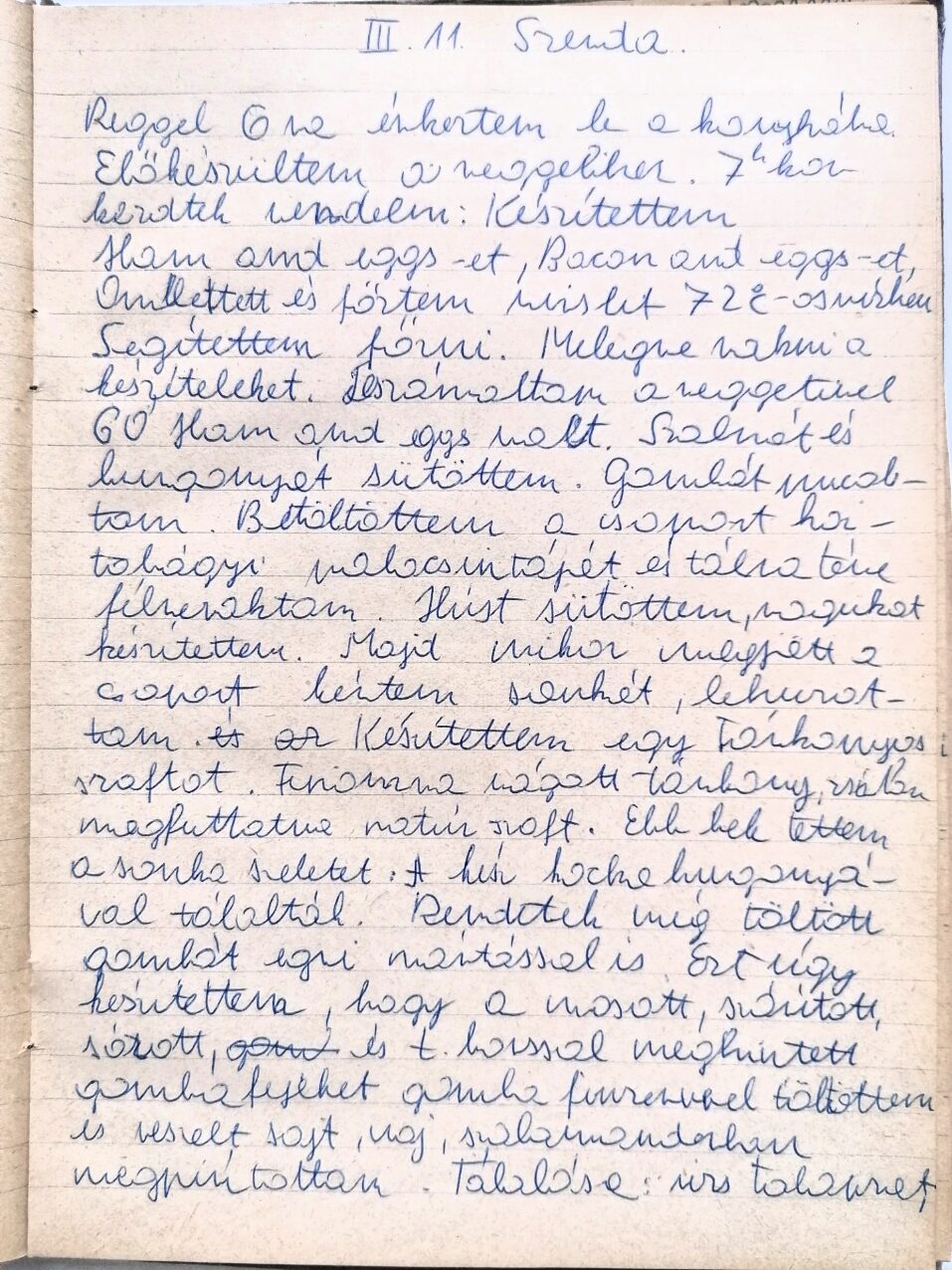
My Work Journal March 11, 1970
Another breakfast shift, Sunday, April 5, 1970—I started work at 8 a.m. From the notes, it’s clear that I was fully occupied with the day’s tasks, which of course required me to perform at the expected high standard. The fact that I took joy in my work is evident from the text, and it was especially an honor when I was sent to serve the dishes—something not typical for second-year apprentices. From the list of plated dishes, one can infer the variety and complexity of the meals served.
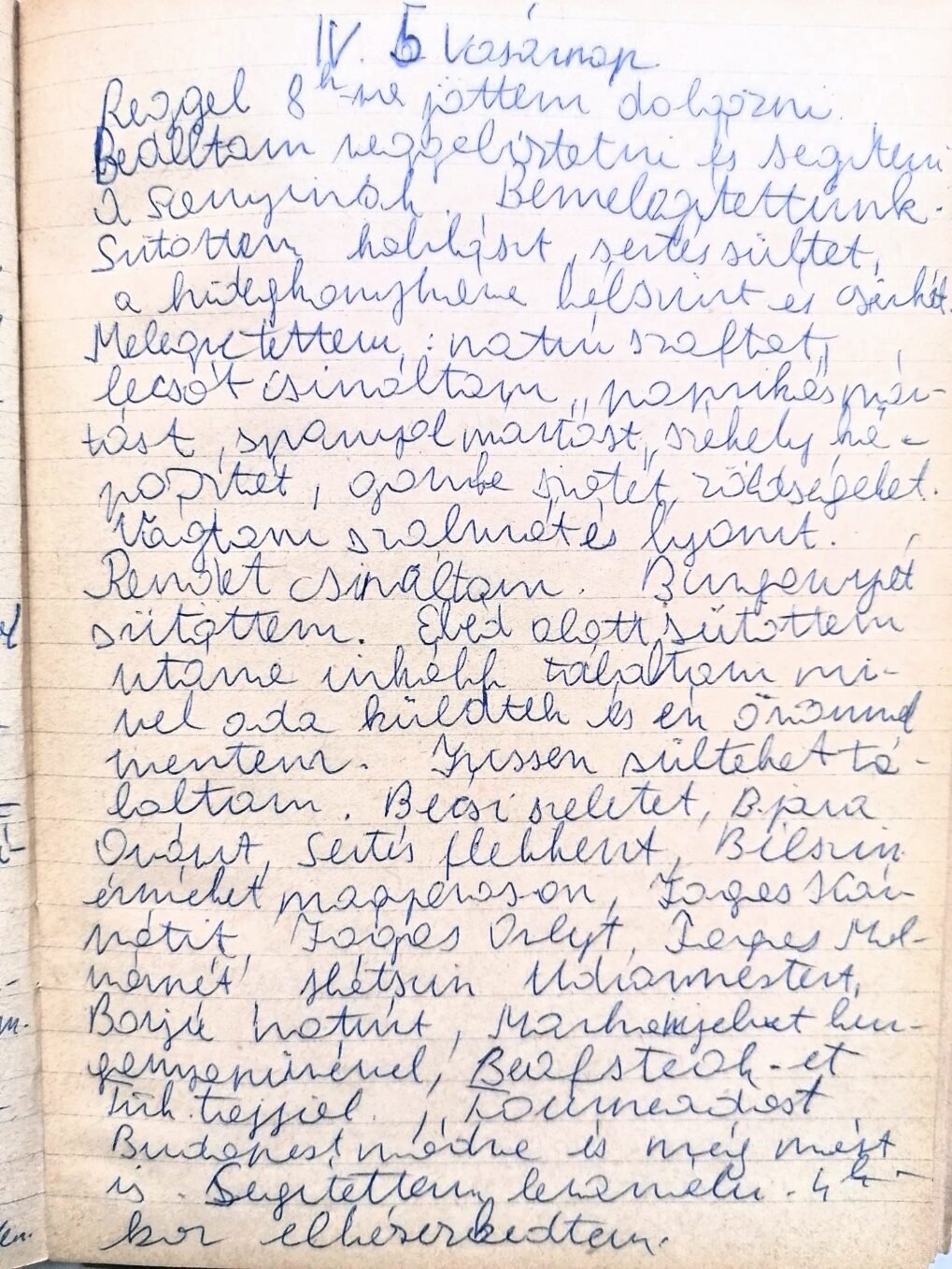
My Work Journal April 5, 1970
The quality of the dishes always had to be 100 percent—not only because of Mr. Juhász’s strict control but also out of my own conviction. The guiding principle was that the experienced and quality-driven chefs would always ask, if something wasn’t perfect, “Would you eat this yourself?” “Because if not, then make a dish you yourself would eat!”
*
While writing this material and reading through my work diary, I discovered a parallel—the use of cooking water, meaning a pot of hot water on the stove, from which we would occasionally ladle into dishes like stews during preparation. This was done for two reasons: first, to ensure the proper consistency, and second, to prevent the food from cooling so it would continue to simmer immediately. At the Sport Hotel around 1970, we used cooking water every day.
In 2006, at the Hospitality College (BGF KVIK), Cristian Broglia gave a demonstration using the very same method. This highly knowledgeable guest chef was the head of the practical kitchen at the famous Marchesi school. Gualtiero Marchesi is one of the greatest figures in 20th-century Italian cuisine. It feels good to find such a connection because it fills me with pride that our Hungarian practice regarding cooking water was identical to that of a top-level Italian chef, even though there was about a 40-year gap between the two events. This parallel, identical practice also exemplifies that not every kitchen and chef was of poor quality during the undeniably difficult period between 1945 and 1990. I will return to the story of the Italian guest chef later.
*
Between 1968 and 1974, the Hotel Sport’s menu typically featured around one hundred dishes, with a great variety of preparations. The permanent menu included categories like “Crayfish, Snails, Frogs,” and the various preparations mentioned earlier, such as Asparagus mousseline or béarnaise sauce, Pastry croûte Csongrád style or princess style, Roasted poussin en Cocotte, Tyrolean veal liver slices, Marengo or Danube pork steak, Monte Carlo veal steak, Veal chop in paper bag, Tournedos favorite or Rossini or Villafranca, Sautéed kidney Turbigo style, Larded venison medallions with Cumberland sauce, and so forth.
At the same time, the menu did not include the roughly ten types of breaded meats, cheese, and vegetable variations that were often negatively associated with the era—and which can still sometimes be seen nowadays.
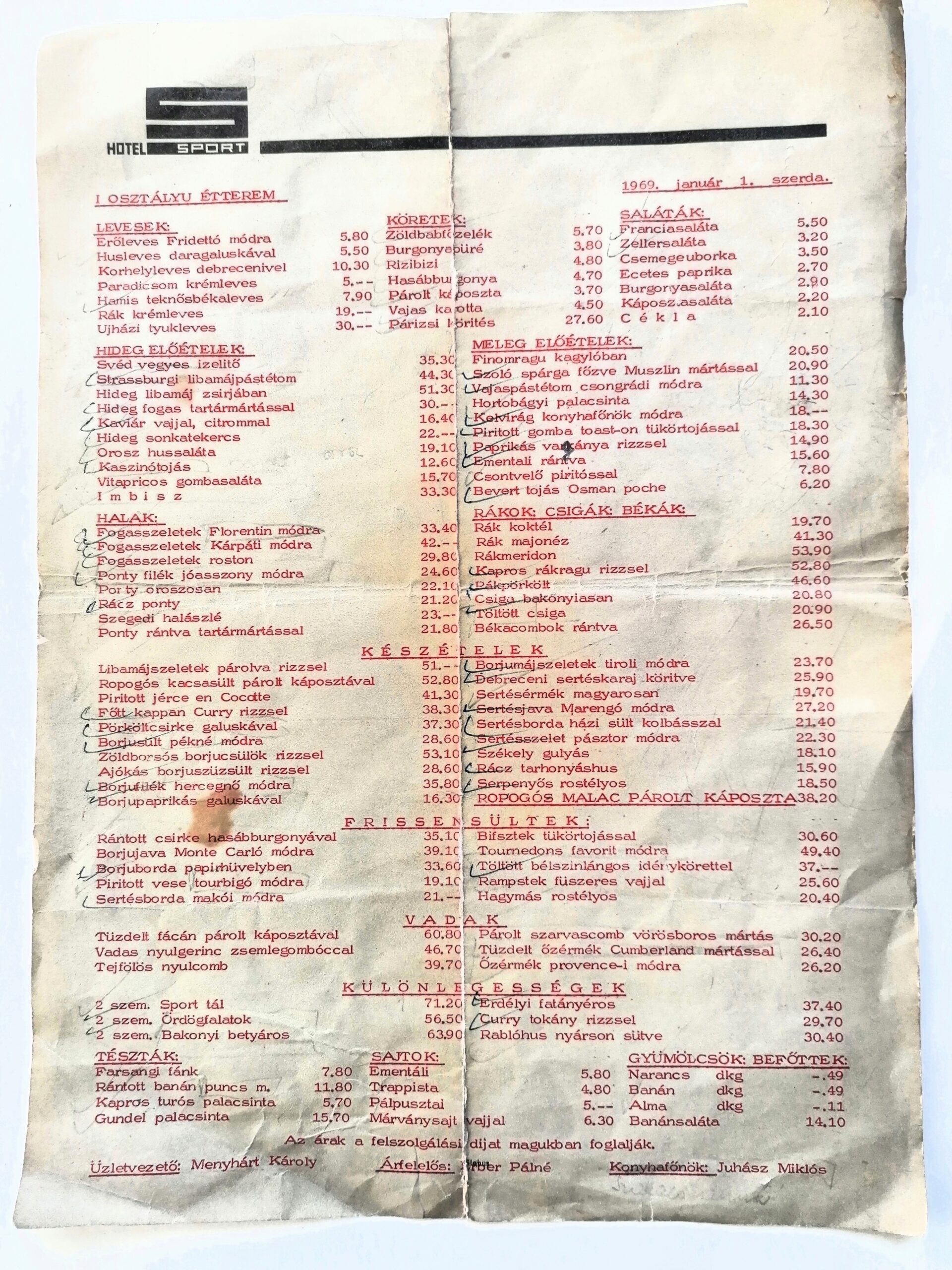
The Menu of Hotel Sport 01.01.1969
*
At that time, I hadn’t yet considered that managing a hundred dishes in one kitchen was an almost impossible task. Procuring ingredients, storing them, preparing, cooking, and properly using leftovers—all these presented operational challenges. It was necessary to ensure the right staff, which carried wage and social contribution costs, the largest expense item within the margin of costs. One also had to account for many other cost elements, such as energy, kitchen equipment, cleaning agents, kitchen textiles, laundry, and so on. Kitchen inventories often showed shortages, mainly stemming from handling the raw materials needed to prepare the wide variety of dishes on the menu.
Back then, I focused on fully accomplishing my own tasks and was glad to work in one of the country’s most prestigious kitchens.
*
Cold appetizers, chilled crayfish dishes, salads, as well as cheese and fruit dishes were prepared in the cold larder. I was fortunate to work not only in the hot kitchen but also in the cold kitchen/larder, so I learned how to prepare all the dishes listed on the menu. The same high standard characterized the work and the preparations here as in the hot kitchen. Here’s an example: for the tomato salad, the tomatoes had to be peeled. On one occasion, for some reason, this was not done. The chef noticed this during inspection. In the hot kitchen, we heard a terrifying yelling and a loud noise (the latter caused by the tomato salad being thrown, along with the dish, into the sink). Another example of the standards: the leavened cucumber had to be peeled, cut lengthwise into quarters, and served on crushed ice on glass plate placed on a chilled underplate, garnished with dill sprigs. Other cold dishes included Strasbourg foie gras pâté, cold goose liver in its fat, cold pike-perch with mayonnaise sauce, asparagus with ravigote sauce, Icelandic caviar, stuffed eggs (Kaszinótojás), cold ham rolls, Imbisz (a type of cold snack plate), and a cold mixed sampler (Cold hors d’oeuvres variées).
*
Occasionally, we had to prepare cold platters for various events. On these occasions, the shifts stretched out very long—sometimes even two days with only brief, uncomfortable sleep in between. One time, I secretly watched the arrival of the guests and the beginning of the food consumption on the buffet platters. After two minutes, I went back to the kitchen and decided I never wanted to see that again. Two days of work vanished in two minutes. It was a disheartening feeling.
Of course, with time I came to see the situation more complexly, especially after attending many events myself as a guest. Naturally, the chef’s word was final when it came to the presentation of the cold platters. The cooks could plate the given cold platter according to their own ideas and then presented it to Chef Juhász. Afterward, the chef would say, “This will do.” Then he’d say, “But I would put this here,” and move one of the sliced items. “And I would put this there,” and relocate another item to the other end of the platter, and so on. The discouraged colleagues would come out one by one, and start plating all over again.
*
On one occasion, at the Hungar Hotels headquarters, Mr. Juhász was asked to refresh the sandwich selection offered at events and, together with other chef colleagues, to develop proposals for this. The chefs met in our kitchen: Ferenc Novák from the Gellért Hotel, István Lukács from Hotel Budapest, and a chef from a regional hotel of the company. The creations of these four chefs were like a special study. Mr. Novák’s mini sandwiches were characterized by refined elegance; Mr. Lukács’s sandwiches were also tasteful in both ingredient use and form; Mr. Juhász’s mini molnárkás (a type of Hungarian open sandwich) and canapé sandwiches reflected thoughtfulness and originality. The deliberately unnamed regional chef’s sandwiches were traditional ham, salami, and cheese varieties.
*
On another occasion, two Chinese chefs were guest chefs in the kitchen. We were amazed and astonished by their speed. We didn’t work slowly either—in fact quite the opposite—but the Chinese chefs were literally like lightning. It was a joy to witness such professionalism and to realize there was still room to grow.
*
It was also a memorable summer evening when, right at the start of dinner service at 7 PM, the power went out — there was a blackout that lasted almost the entire evening. We immediately lit candles and, as if nothing had happened, managed to carry out — as it turned out afterward — the busiest dinner service of that year. This was possible partly because the stove ran on gas, and instead of using the electric fryer that was out of commission, we fried the deep-fried potatoes in pans on the gas burners. But mostly, it was a special kind of energy that drove us through the night.
There were a few businessmen who were regular guests at the hotel. Among them, Van Rijn, a Dutch meat trader, had free access to the kitchen. He always brought some kind of meat with him, usually a whole sirloin or veal saddle. He would walk in from the restaurant, carrying the meat through the office and down the corridor to the meat preparation room, where he’d place the meat on the block. While greeting, he would friendly and manfully pat butcher Tóni on the back—both were of strong build—then showed him how to slice the meat. On his way back to the restaurant, at the serving table, he would tell the colleague there: “Ohne salz, mit butter” (without salt, with butter), referring to how the meat should be cooked. He would also ask, “Pici bor iszik?” (Would you like a little wine?). The answer was always the same… 🙂 We cooked the 6-8 sizable steaks medium rare in the largest frying pan. When the dish was served with side dishes and salads, by then the waiters had brought a promised bottle of wine into the kitchen, along with a few bottles of beer as a bonus. There is a photo taken in the Sport Hotel kitchen, probably around 1972, showing the well-deserved beer at the end of the shift, likely after Van Rijn’s visit.
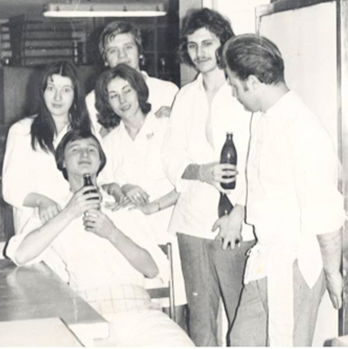
Irma Tóth, László Ledniczky, Éva Kis, János Arany, me, Zsigmond Szabó
According to legend, during the winter season Van Rijn and presumably the other businessmen were the ones supporting the hotel. When the Dutch merchant was a guest, money didn’t matter. He felt comfortable not only in the restaurant but also in the night bar, where he had a peculiar habit: he would approach another male guest enjoying himself and with the scissors in his hand, cut the man’s tie just below the knot. The startled man was left speechless, but Van Rijn slipped a hundred-forint note into his hand. By the middle of the night, the bar’s atmosphere was quite amusing, as men were dancing around with their ties cut off.
On one occasion, during a lunch, my elementary school homeroom teacher, Aunt Klári, visited. She ordered a Wiener schnitzel, which of course I prepared. At the end of the meal, I went out to the restaurant to see her, and she thanked me warmly for the delicious food, saying she was proud of me and glad I had chosen such a good profession. As I wrote earlier, she helped me get started working at the Hotel Sport as a culinary apprentice.
Click on the image to watch the “Lobster Cream Soup with Lobster Butter” video made at the Joyful cooking event!
You can find the recipe below the video!
You can watch the interview with Csaba Horváth on YouTube by clicking here.
The spontaneously told stories from the Joyful cooking event can be found here:
https://www.youtube.com/watch?v=pTQUNw_9rew
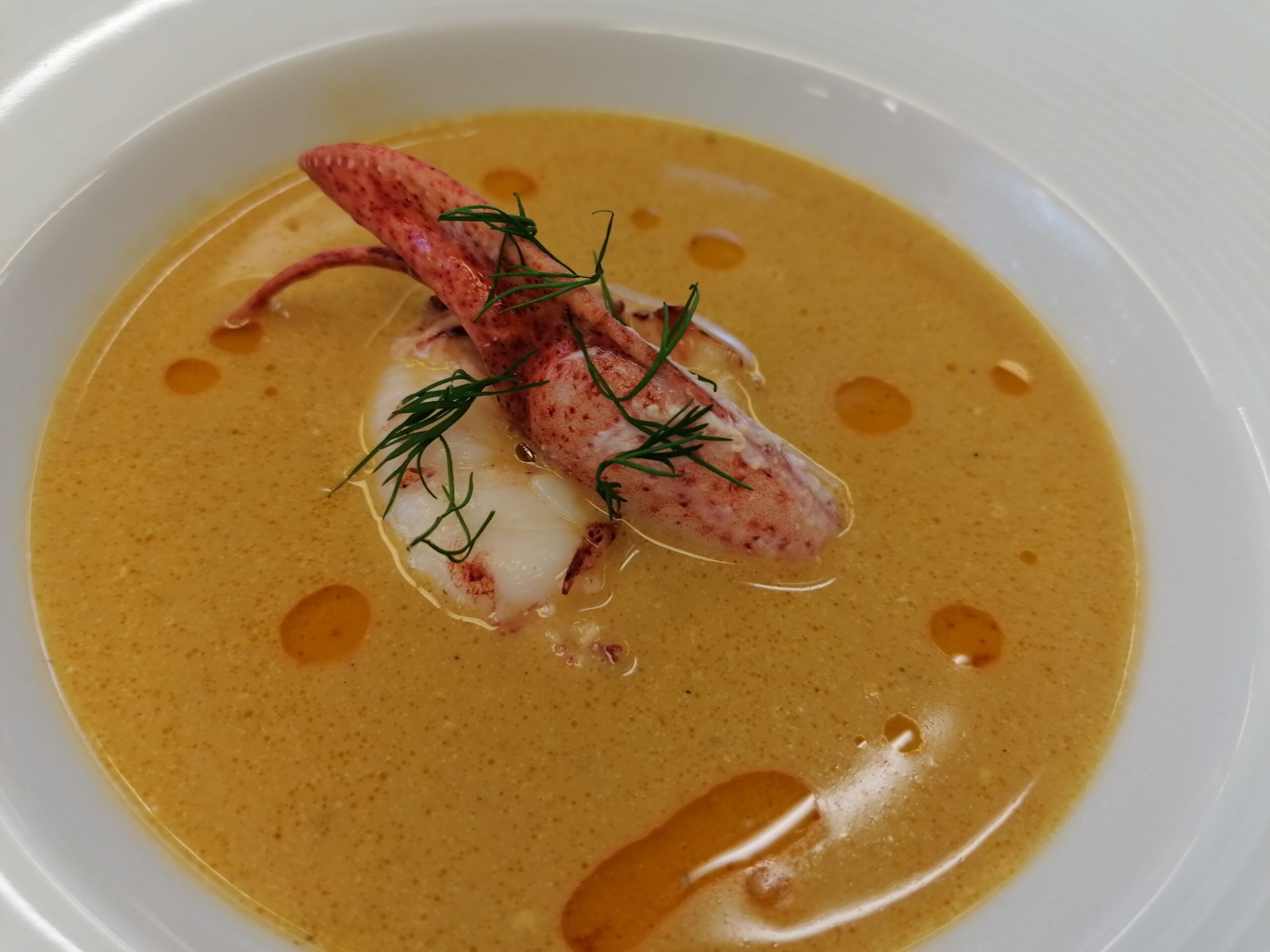
Lobster cream soup and lobster butter
Recommended Ingredients for 4 servings:
1 lobster
for the cooking liquid:
boiling water (should cover the lobster)
parsley,
dill,
caraway seeds,
salt.
for roasting the lobster shell:
80 g butter,
cooked lobster shell,
80 ml brandy,
for the lobster butter:
80 g butter,
cooked lobster shell
sweet ground paprika.
for the cream soup:
cooked lobster shell
60 g onion,
60 g carrot,
60 g celery stalk,
20 g tomato purée,
30 g flour,
100 ml white wine,
bay leaf,
thyme,
100 ml cream,
cayenne pepper.
The preparation steps:
Put the live lobster into an ice water bath and optionally into a shock freezer for hibernation.
Cook the lobster in boiling water seasoned with salt, caraway seeds, parsley, and dill for 6-8 minutes, then cool it down in ice water and clean it. Reserve the cooking broth.
Remove the meat from the lobster claws and tail; clean the digestive tract from the tail meat. Set the meat aside.
Start preparing the lobster cream soup base and the shrimp butter simultaneously by melting butter, adding the cooked lobster shells, and sautéing them; then flambé with brandy (pour brandy and ignite).
For the shrimp butter, take a small amount of lobster shells into a pot, sprinkle with paprika powder, heat gently with butter, then strain.
For the cream soup, add diced onions, carrots, and celery to the larger quantity of lobster shells and continue sautéing.
Add tomato purée; when it turns rusty brown, sprinkle with flour, cook further, then pour in the reserved lobster cooking broth and stir until smooth.
Add white wine, bay leaves, thyme, and simmer the soup for one hour at a gentle simmer.
Strain the soup, add cream, cayenne pepper, and salt to taste.
At serving, heap the cooked lobster meat on top and drizzle with the shrimp butter.
*
Preview
Hotel Sport and Cooking School Part 2.
Joyful Cooking with István Ferenczi and János Cseh, with whom I was schoolmates at Culinary School between 1968-71.
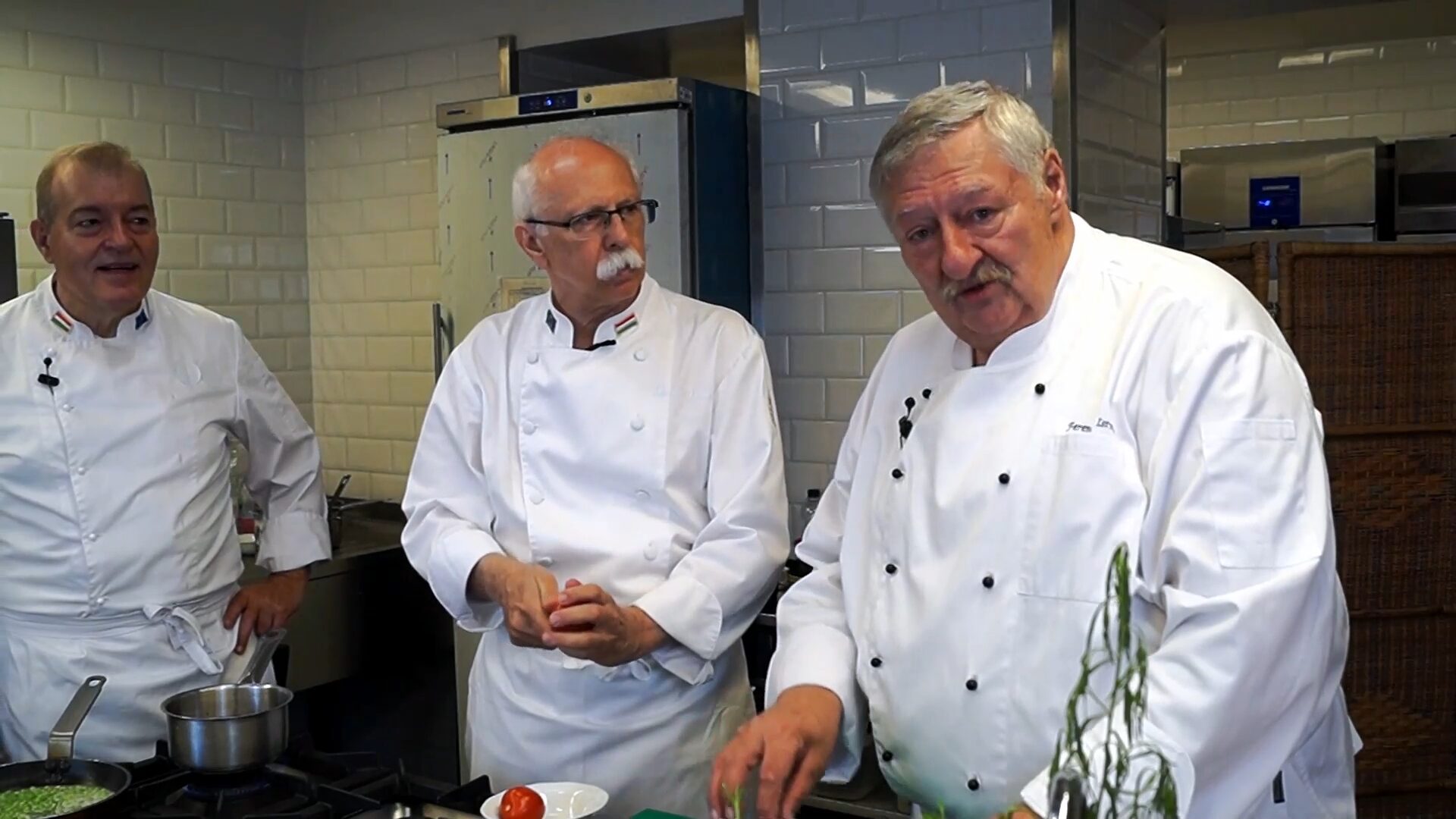
With István Ferenczi and János Cseh