Hospitality College (KVIF, BGF) work 1992-2004 Part 1
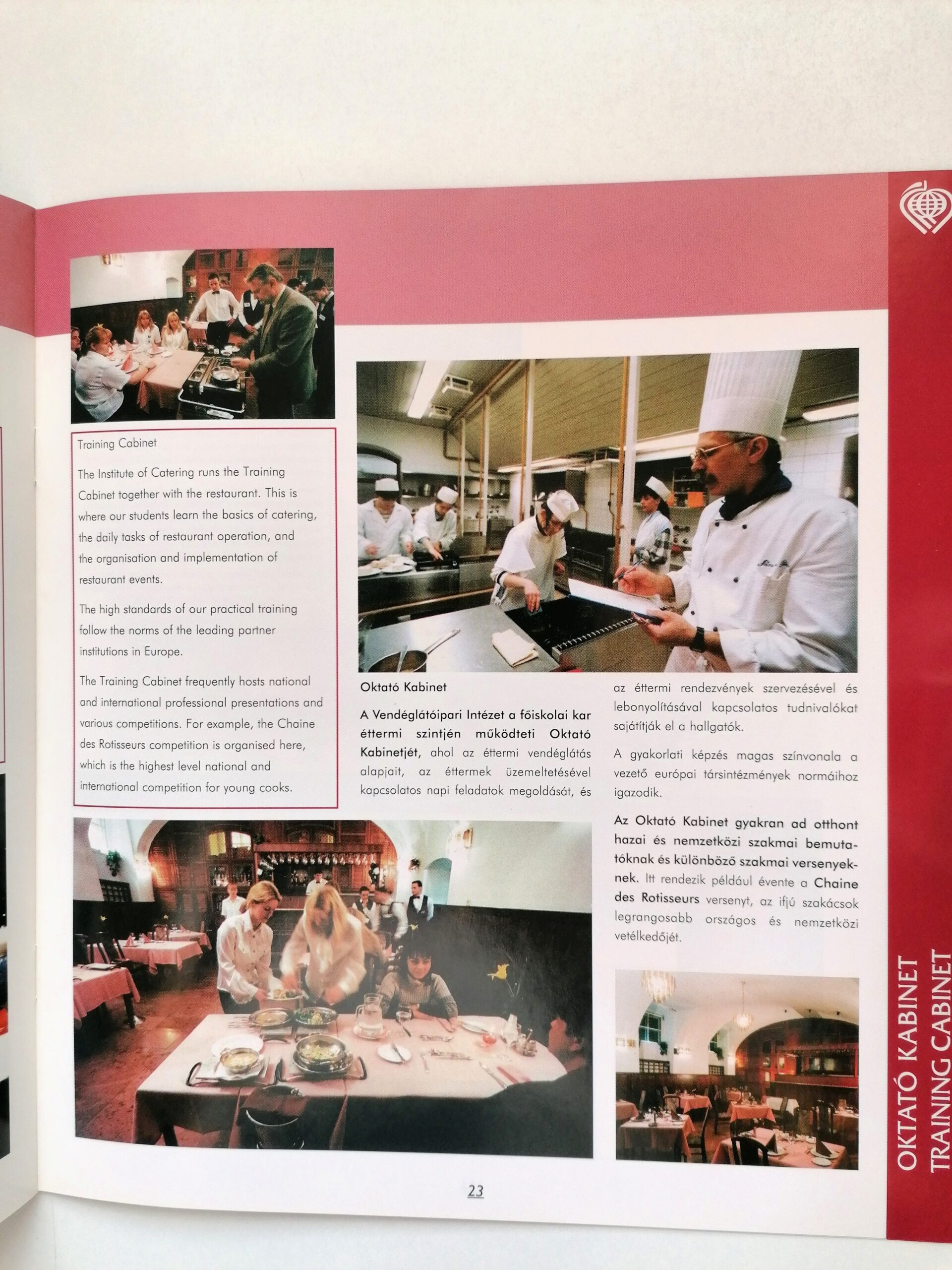
As soon as I returned from Seville, the 1992/93 academic year almost immediately began, and we launched the brand-new Teaching Cabinet, which consisted of a connected training kitchen and training restaurant. Of course, the preparations and work necessary for the start had already begun well in advance. The training kitchen was designed with 12 workstations but arranged so that it was suitable for so-called restaurant operation — practical sessions involving guests — as well as for organizing project events. The wood paneling of the training restaurant and the corridor was decorated with Imre Makovecz’s tulip motifs. The training restaurant was also suitable for conducting all types of practical exercises.
The equipment of the Teaching Cabinet was excellent: stainless steel cookware, machines, and appliances in the kitchen, and a full set of tools in the restaurant that met every need, making it suitable for practicing various serving methods. The entire curriculum for the training kitchen and restaurant practical sessions was developed according to what I had learned in England. Basic and, building upon that, operational and project practices. The whole formed a complex system and was suitable for the practical training of students coming mostly from high school, with no prior hospitality experience.
The practical knowledge and skills acquired, supplemented by theoretical knowledge and external, often year-long practical experience, provided a solid foundation for students graduating from KVIF.
*
The official inauguration of the Teaching Cabinet took place in the first days of September 1992, when the wife of the Canadian Governor General visited the college. When she entered the training kitchen and saw the Foster industrial refrigerators, she exclaimed, “Oh my God, we have the same fridges in Canada!” She liked everything very much, and when I outlined our educational concept to her, she expressed her appreciation.
With the launch of the Teaching Cabinet, a new era began in the life of the college — a period that elevated hospitality training to the higher education level of developed countries, thereby also enhancing KVIF’s recognition both domestically and internationally.
I was appointed head of the Teaching Cabinet in 1992 and remained in that position until my retirement at the end of 2017.
*
At the same time, between 1992 and 1995, the training workshop located in the basement of the college also became an educational unit and was placed under unified management. György Györe was its director, I was the deputy director of education, and Csaba Revuczky was the business manager. Györe Gyuri, as everyone called him, had previously worked among others at Hotel Astoria, the Kárpátia restaurant, and the New York Café, where he was the restaurant manager. Gyuri was famous far and wide for his humor, so even at the most unexpected moments, he had huge quips.
On one occasion, dr. László Csizmadia, the chief director, was our guest in the Teaching Cabinet, and after a well-organized event, he thanked us for our work by saying, “You were not bad, kids.” To which Gyuri replied with a smile on his face, “Lacikám, what if you said once, ‘It was good’?”
On another occasion, dr. László Csizmadia was again the main actor, who, seeing us in the restaurant, made the following comment: “You two should be combined to make a proper build out of you.” I have a taller, slimmer build, while Gyuri was stockier, with a belly that showed his so-called “diet.” Teacher Csizmadia continued, “Why aren’t you both ‘properly’ built?” Gyuri replied with a smile, “I have a belly because Dénes is the cooking teacher and he cooks for me, not the other way around.”
By the way, Gyuri’s diet looked like this, and he gladly reported: “Imagine, last weekend Irénke (Gyuri’s wife, who cooks very well) and I started dieting, you know I have to lose weight.” He continued: “That’s why it was stuffed cabbage, because cabbage is healthy. It’s true, I ate eight servings, a box of homemade sour cream, six slices of bread, and washed it down with five beers, but cabbage is healthy.”
*
During this period, hospitality education was at its most realistic, as students could practice everything from foundational training to small group kitchen and restaurant operations serving about 20 guests, as well as organizing events for a similar number of visitors. Alongside these, they could also gain hands-on experience managing a large kitchen and its connected restaurants, as well as conducting external events.
The following pictures show, on one hand, a page about the Training Cabinet (the college’s teaching kitchen and restaurant) from a college brochure made in the 1990s. On the other hand, there is a newspaper article about the same topic.
A brief description of the Training Cabinet in the 1990s
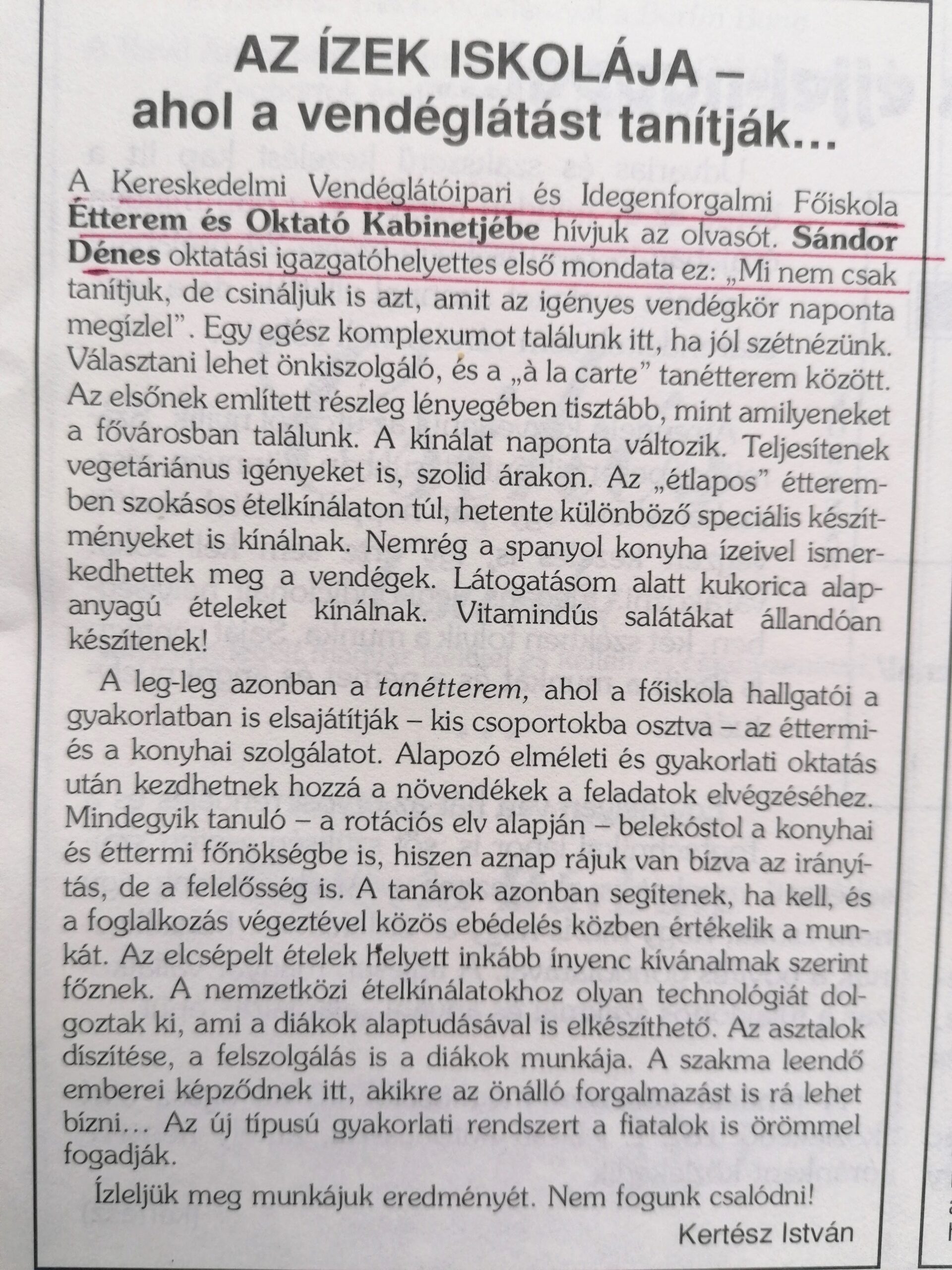
An article about the Training Cabinet from the 1990s
*
This well-functioning system still ceased after three years of prosperity because the college’s financial manager regarded the unit as a commercial hospitality operation, which, of course, was unrealistic since we also carried out a significant amount of educational activity—indeed, this was our main profile. Due to this erroneous classification, the financial figures showed a deficit. No matter how much we explained that all departments were running at a loss at that time, because they also did not generate enough revenue to cover salaries. Our involvement in the story ended when we noticed that the so-called projected costs (costs calculated based on the unit’s square meter ratio within the total college area) included items that were additionally charged to our expenses. For example, there was the elevator maintenance fee and other items, where the cost was counted both in the projected costs and again separately included in our actual expenses, such as the elevator maintenance fee. This kind of attitude from the college’s leadership at the time was unfair, and moreover, the method of calculation was not professionally correct.
*
Accordingly, I continued managing the Educational Cabinet, which was officially recorded as a purely educational unit—literally.
Among my colleagues was György Györe, who was responsible for the training restaurant section, and Anikó Szőcze, who joined the college in the 1980s as an educational technician but was already working as a cooking instructor by then. Ancsa helped me for decades with kitchen practice. We understood each other with half a word. Preparing an order list was never a problem for her; she completed her work lightning-fast. She had an impulsive personality, so she had quite a few conflicts, especially when she felt someone was treated unfairly.
Hedvig Hidvégi followed a similar path, and I handed over the leadership position of the Oktató Kabinet to her in 2017. Hédi, or as we called her, Hedó, is calm, thoughtful, reliable, and capable of bearing enormous burdens—physical, emotional, and mental.
Krisztina Rossi also started as a technician with us and, like the colleagues mentioned above, completed the college’s instructor program while working, becoming a Restaurant instructor. Later, in the second half of the 1990s, Gyula Kerekes joined the restaurant team; he had previously been the restaurant manager at the Europa Hotel in Siófok.
Just as my female colleagues advanced from technicians to instructors, we had new technician colleagues who participated in preparing and running the practicals—mainly by ensuring raw materials. For example, Andy Szalai was a technician, who, in addition to her basic work, helped a lot in the administration of my PhD work, for which I would like to thank her very much. Viktor Pocsai, who
solved “everything” efficiently. Brigitta Tóthné Czibi and Zsuzsa Lőcsei, who helped a lot in organizing
the joy cookings, for which I would like to thank him very much. Without my excellent colleagues, the Oktató Kabinet would not have operated so successfully. I hereby sincerely thank them for their decades of professionally high-quality, conscientious, and persistent work!
*
In the English-language program, dr. György Cservák was the main instructor for Basics of Gastronomy and the foundational restaurant operations courses, while Endre Bártfai taught the Student Project (event management) course. On one occasion, Endre specifically studied this subject at Manchester Polytechnic, later Manchester Metropolitan University, a partner institution. Unfortunately, Gyuri can no longer say this himself—so I say it on his behalf—that he always resented not being able to teach the Student Project course as well. He was both right and not right, because with his previous hotel industry experience, he certainly could have taught that subject too.
At the same time, since he already had many hours teaching the other aforementioned courses, and Endre began teaching the Student Project based on his experience in England, every year I asked Endre to teach this course. Moreover, Endre had no other restaurant-related subjects.
Poor Gyuri constantly grumbled about how great it would be if he could teach the Student Project, because then he could carry through all the restaurant subjects in the English-language program. He was both right and not right… I would gladly listen to Gyuri’s grievances again and again, but I cannot anymore, as he now enjoys the company of angels.
*
The training program in the teaching kitchen and training restaurant worked well, as a first-year student who joined us without having graduated from a vocational secondary school was able, by their third year, to develop in hospitality to the extent that they could even surpass in professionalism a classmate who had completed vocational secondary school. Of course, this also required the individual’s ambition and the right attitude.
*
The curriculum for hospitality-related subjects taught by the Teaching Cabinet from 1992 to 2017 was basically as follows:
In the 1st semester: Basics of Gastronomy (theory),
In the 2nd semester: Food Preparation 1 and Restaurant Service 1 foundational practical courses,
In the 3rd semester: Food Preparation 2 and Restaurant Service 2 restaurant operations practical courses,
In the 4th semester: Student Project (event: planning, organizing, execution practice).
The students’ knowledge was also expanded with material from other subjects, such as Food Science, Nutrition, Technical Knowledge, Microbiology, Hospitality Management, Hospitality Organization, etc.
Added to all this was a one-year professional internship at an external site—either a hotel or a restaurant anywhere in the world at that time. The establishment of foreign relations is primarily thanks to dr. László Csizmadia, who led the institution between 1993 and 2002.
*
From 1992, foreign language instruction began in the Hotel and Tourism program. I was fortunate to participate in the development of the curriculum and teaching materials alongside my colleagues from the college and Manchester, as well as actively working with leaders in the respective fields. I joined the English-language program as an instructor from the very start and remained involved until my retirement in 2017.
In both the Hungarian and English programs, I taught the following subjects: Basics of Gastronomy, Food Preparation 1 and 2, Student Project, and as an elective, Special Food and Beverage Knowledge.
*
The Training Cabinet (Training Kitchens–Training Restaurants) made good use of being the base for higher education hospitality training at a market-leading institution, and accordingly became a popular venue for various domestic and international events, competitions, and demonstrations.
Among the many domestic events, it is worth mentioning the gala lunch organized in the autumn of 1993 on the occasion of the publication of the book titled “Gastronomic Lexicon,” edited by dr. László Csizmadia, and published by Mezőgazda Publishing House. The dishes on the menu appeared in the lexicon, which was obvious for two reasons. On the one hand, I had the fortune to participate as a professional reviewer of the publication, so I had ideas regarding the selection of dishes; on the other hand, it was the best possible occasion to give, quite literally, a small taste of the book. The menu was as follows: Cold tofu turkey roll, Consommé Napoléon style, Poached quail egg Sárvár style, Plaice Fontainebleau style, Lemon sorbet, Filet mignon Marianne style, Malakoff pudding.
An article about the event appeared in Pesti Hírlap on November 13, 1993.
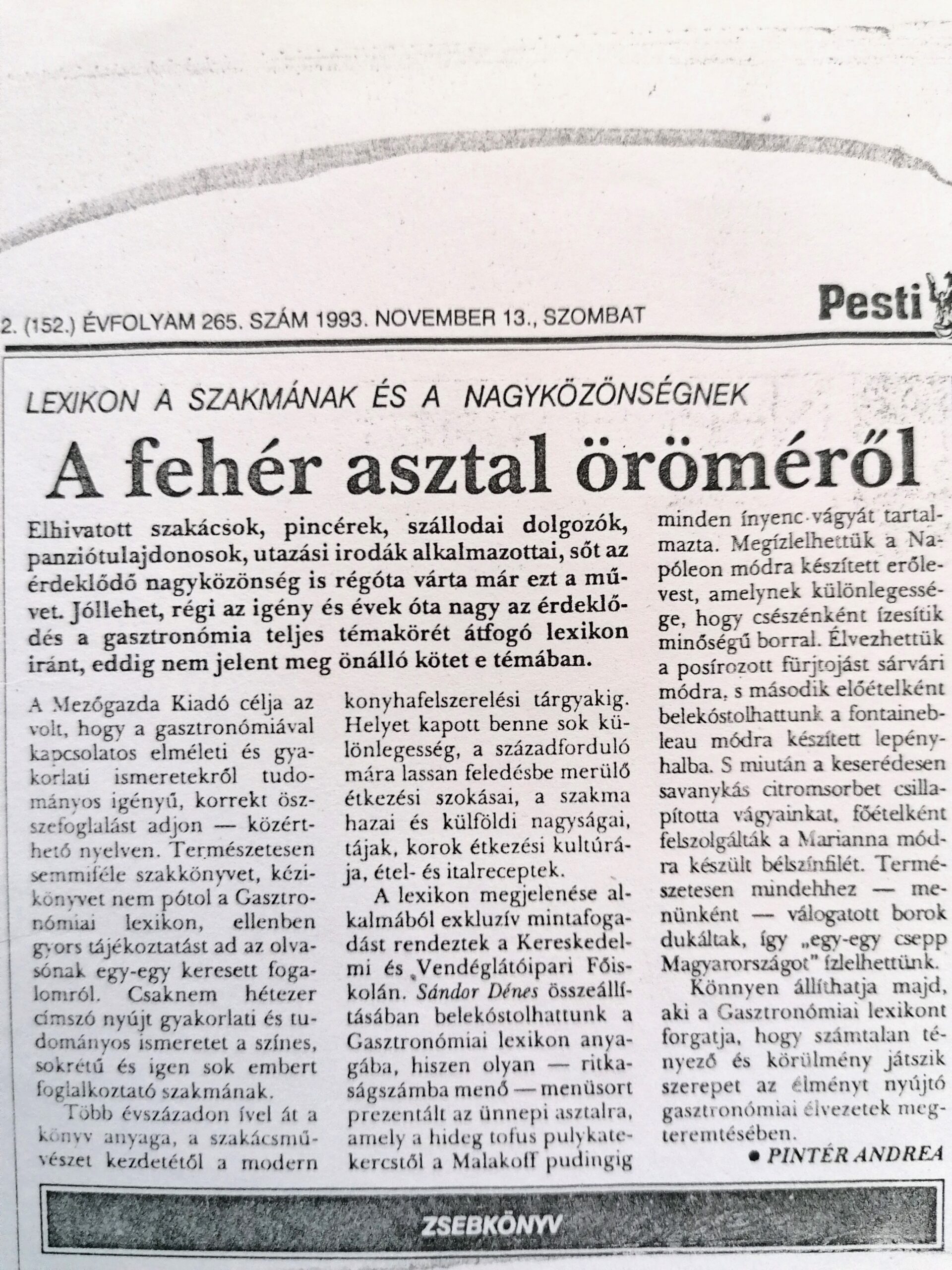
An article about the gala lunch held on the occasion of the 1993 publication of the Gastronomic Lexicon
*
In May 1994, we organized a gala dinner for Ferenc Mádl, the Minister of Education.
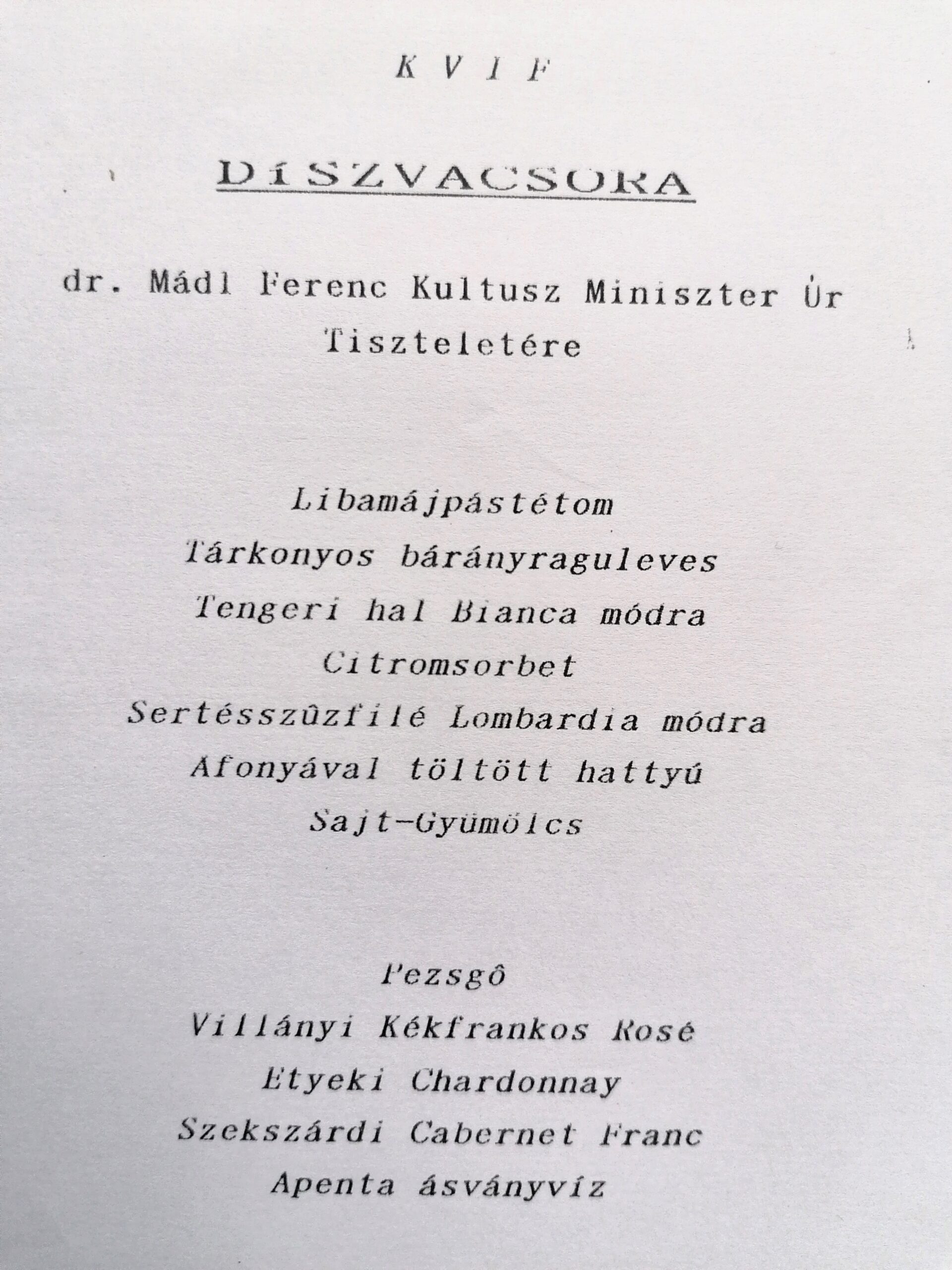
Menu in honor of Ferenc Mádl, Minister of Culture, at the college in 1994
*
In February 1995, the evening dinner of the Budapest Chamber of Commerce and Industry was also a notable event, the menu (food and drink list) of which can be seen in the following image.
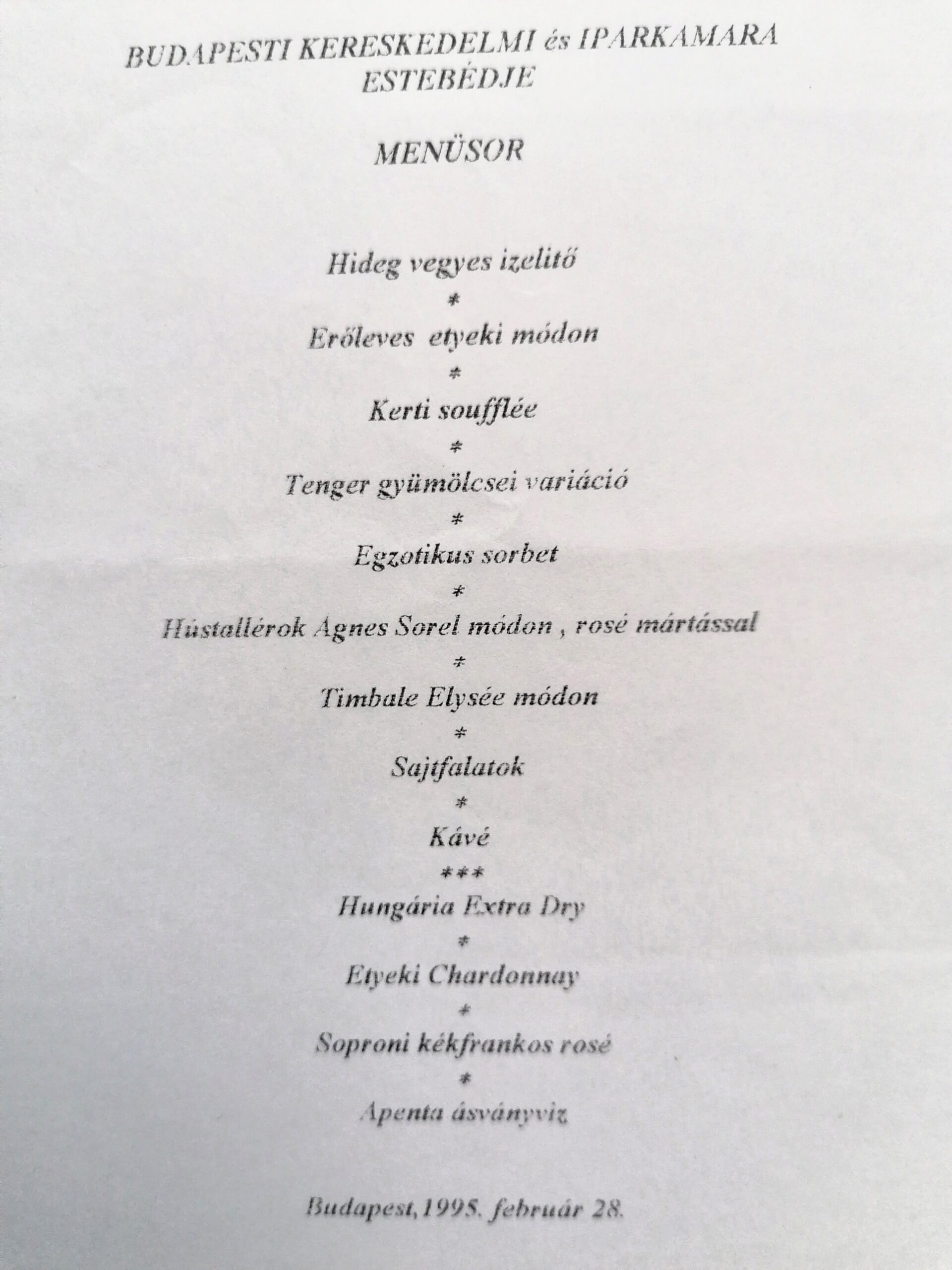
The BKIK menu in 1995 at the college
*
In February 1996, György Alpári, who as a chef and CEO of Agrocorp Kereskedelmi Rt. highly valued Japanese gastro-culture, organized an authentic Japanese gastronomic event at the Teaching Cabinet. Following an interesting lecture by professor Hiroko Fukohara on nutritional science issues, the staff of the Department of Food Science attended. Toru Haihsi, the guests’ head chef, and Yasuko Takahata, the restaurant owner, carved cherry blossom petals out of carrots and frogs out of cucumbers the night before the presentation for the decoration. Together with the students, we learned firsthand the secrets of making tofu, cooking rice, and preparing sushi filled with nori (seaweed). The following photos show scenes from the event.
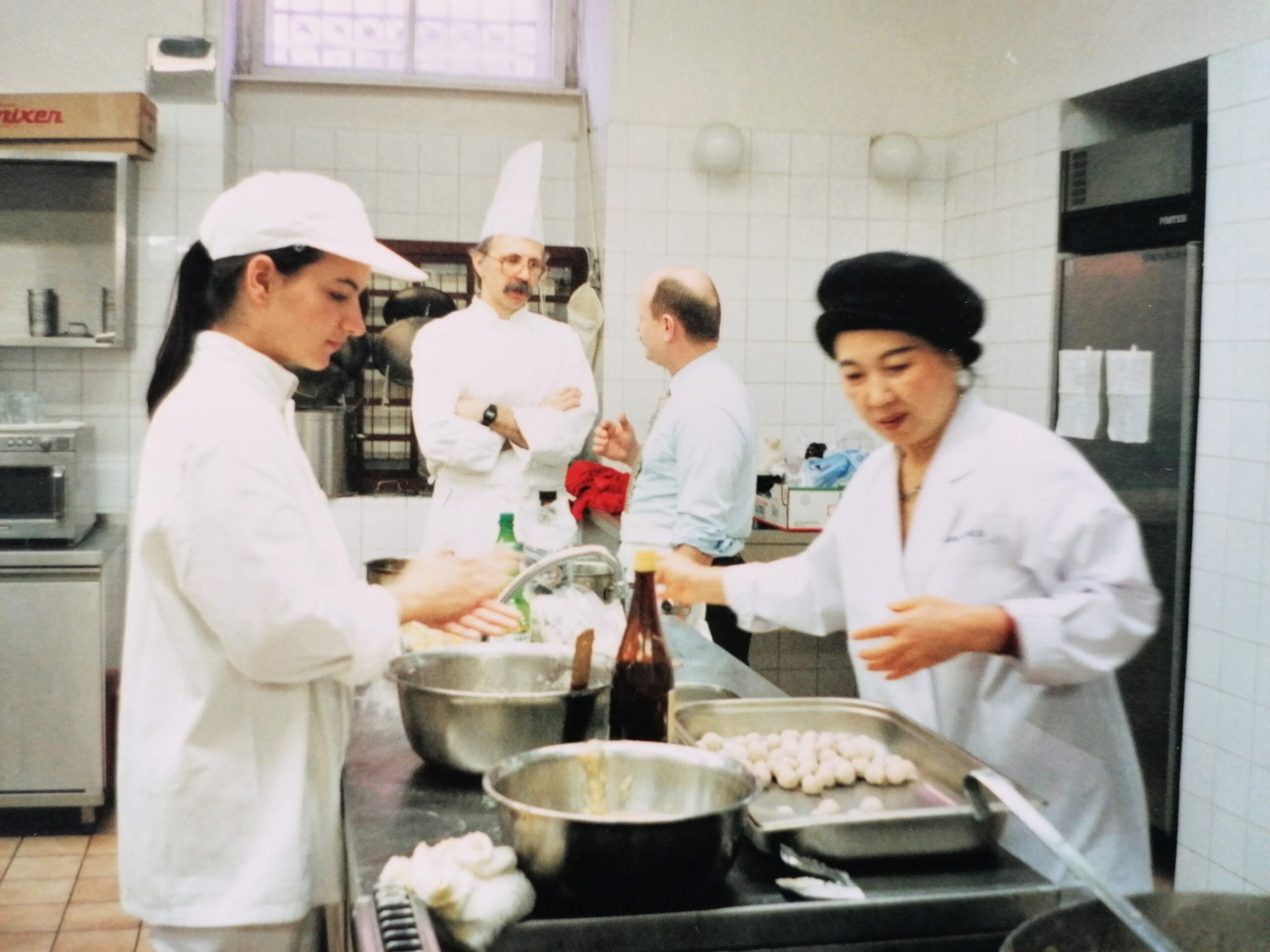
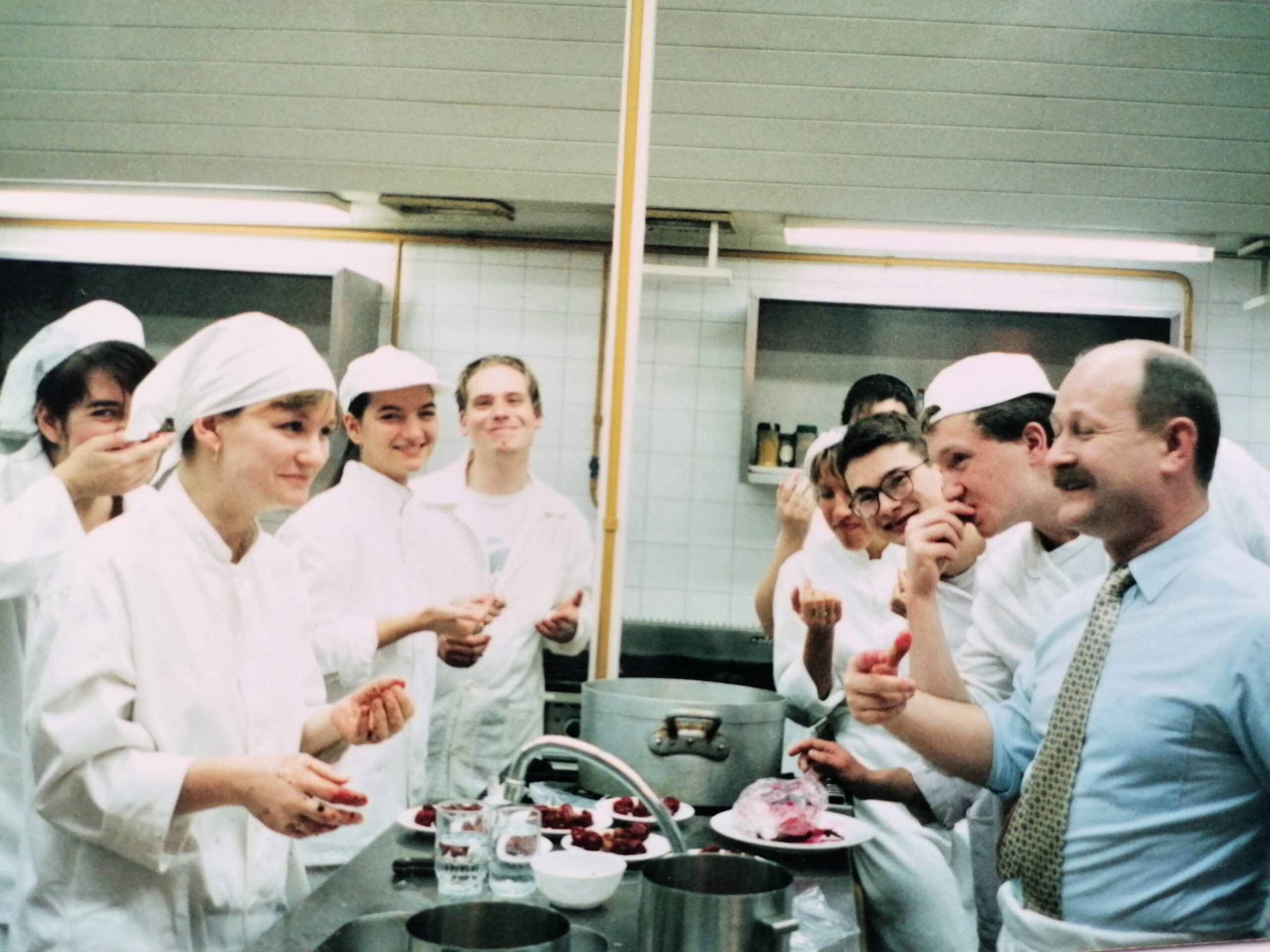
Japanese cooking on February 23, 1996, at KVIF
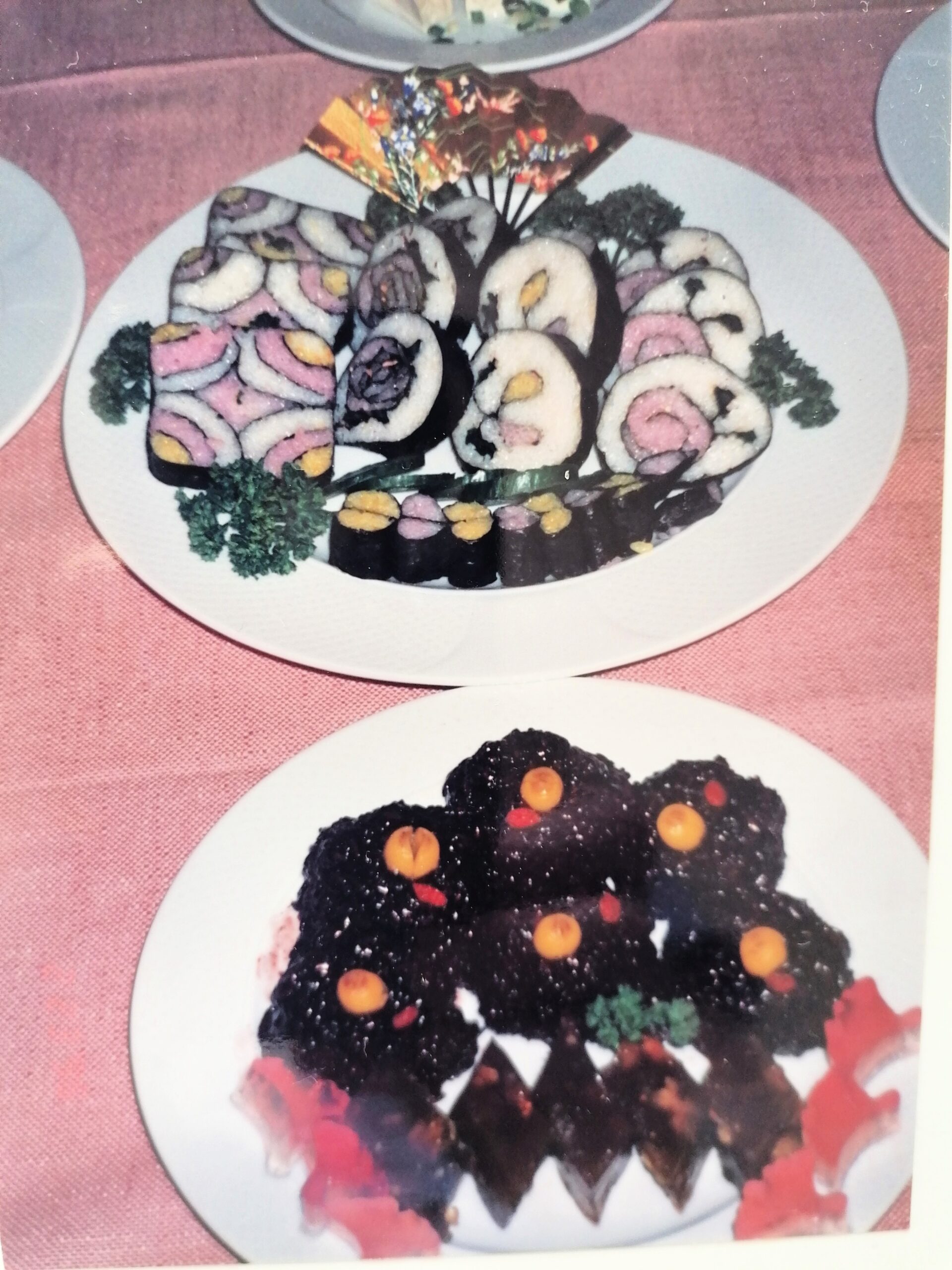
Sushik
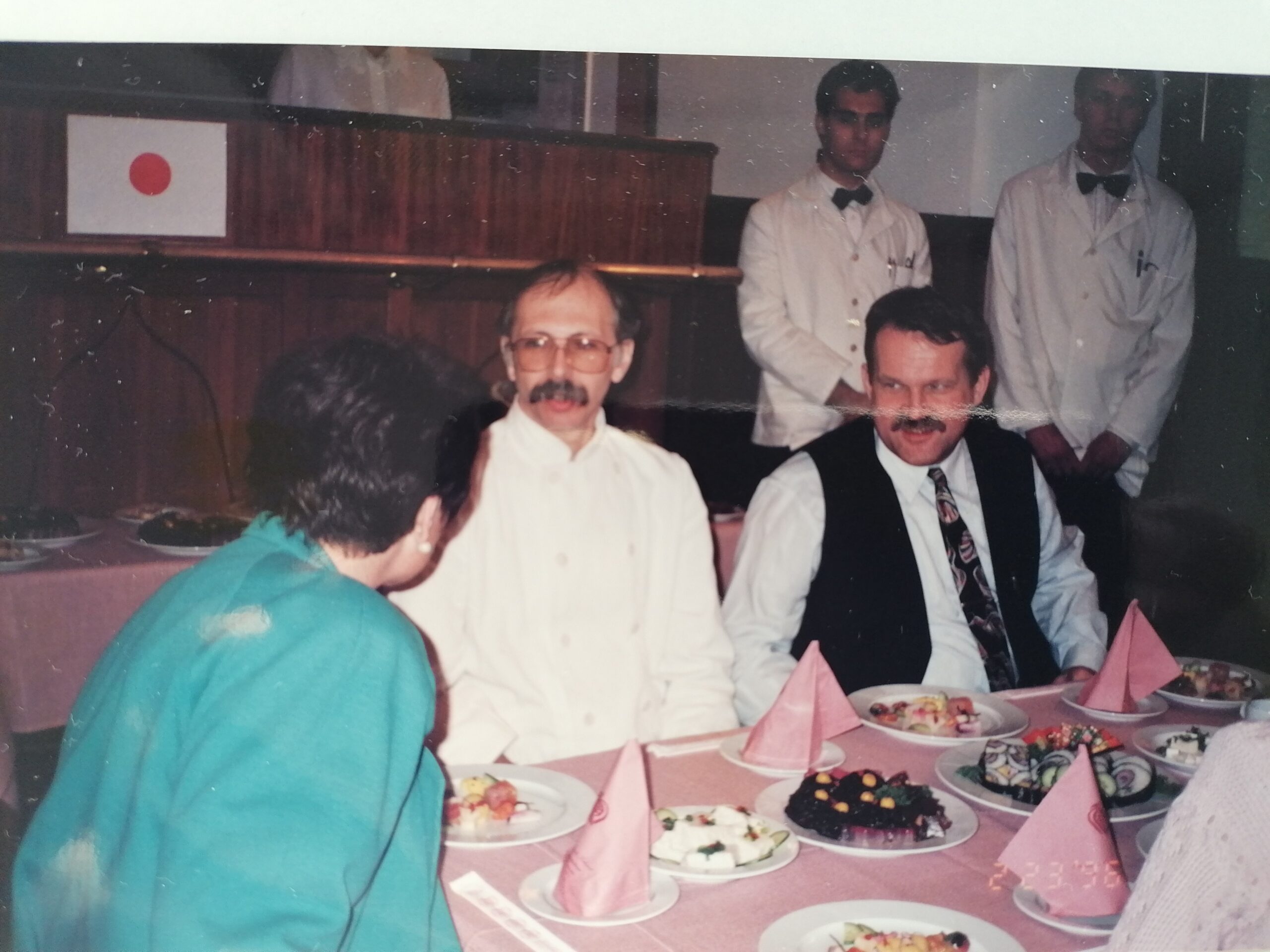
With György Györe at the Japanese event
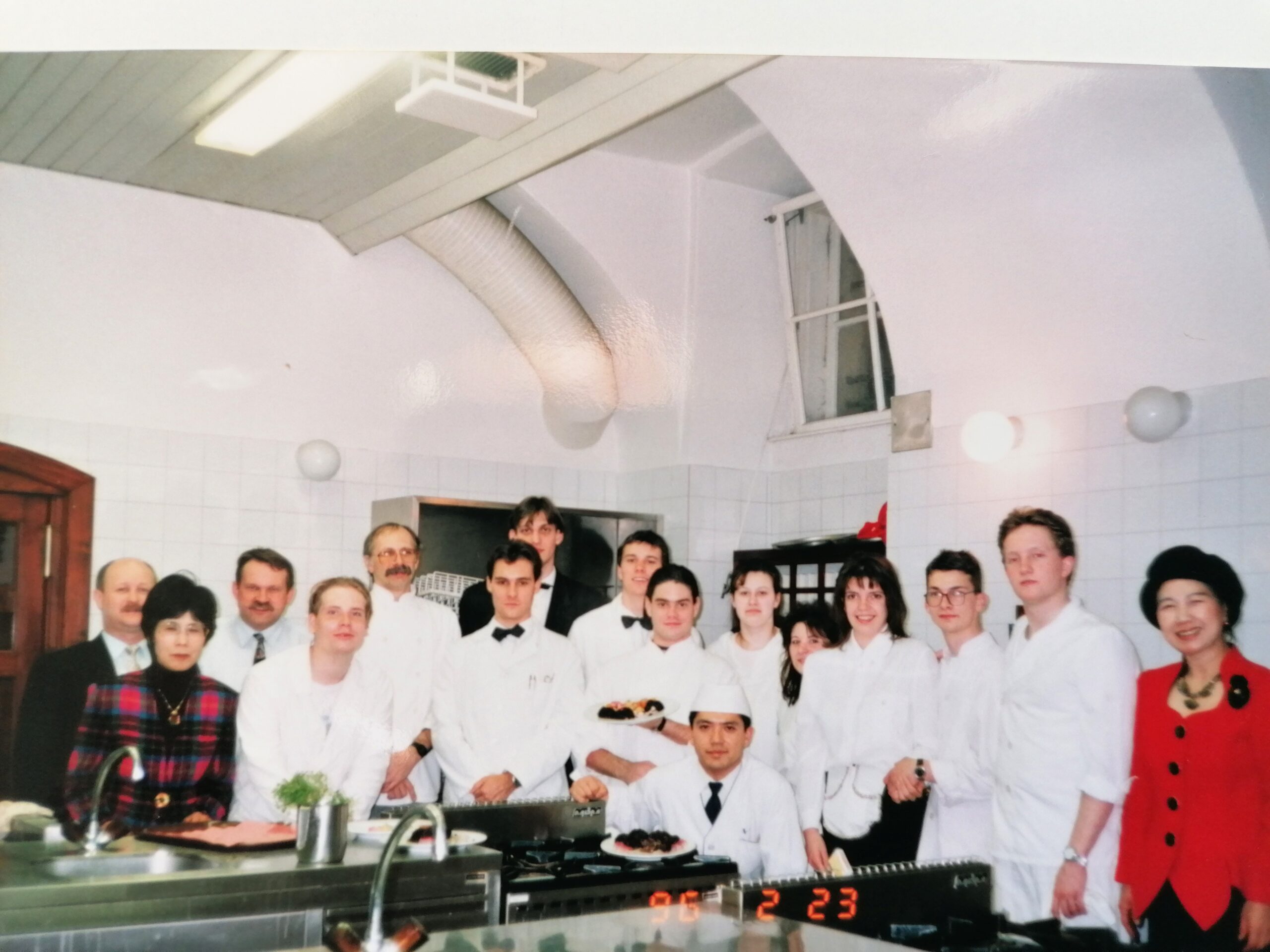
Participants of the Japanese gastronomic event in the training kitchen on February 23, 1996
*
In 1996, to commemorate the 1100th anniversary of the Hungarian Conquest, we held a large-scale series of events throughout the entire building on Alkotmány Street. Regarding hospitality, the gymnasium served as the venue for the feasts. Péter Mózes, who was then working at the Fortuna restaurant, was the guest chef. There was no authentic recipe available, but with the help of historians, we gathered information about the raw materials that could be used. With Péter’s assistance, we created the dinner dishes from these ingredients. chef Csaba Nyers also helped us.
Our concept was to place on the wooden tables—before the guests arrived—edible decorations such as unleavened flatbreads, fresh and dried fruits, fresh herbs, oilseeds, and edible flowers.
Following this, the following dishes were served in a traditional menu:
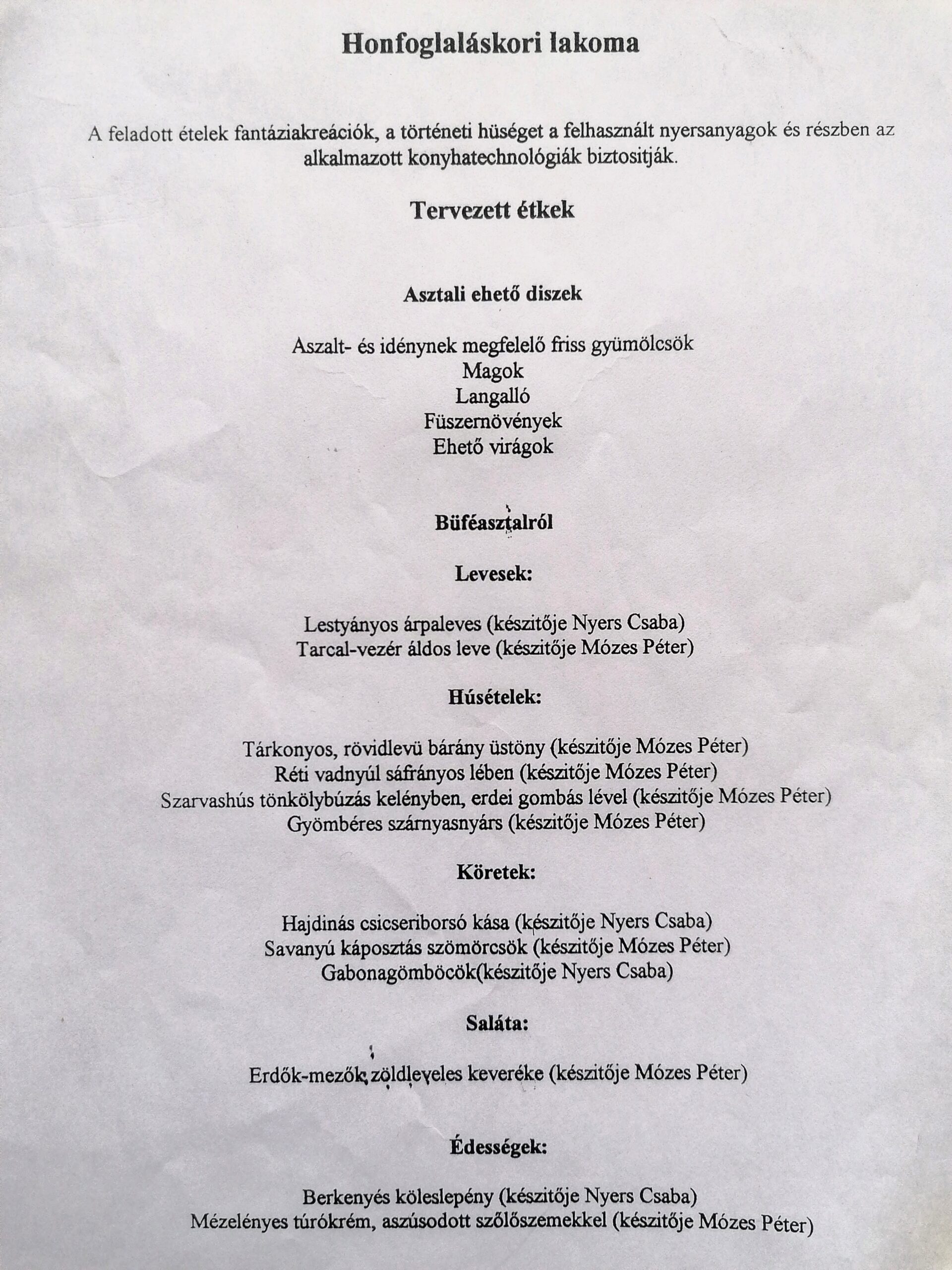
Menu of the 1996 Conquest Era Feast at KVIF
It was a good feeling to work again with Péter, who was my fellow student from 1968 to 1971, for a few days. I heard two stories related to the event from Péter Szikora, who was working as a helper in the kitchen at the time.
The first one: On the very first day, when he and a companion arrived at the college, I asked them, “Where did you come from?” He replied, “From Nyugati” (the Western Railway Station). I said, “Alright, then let’s have a shot of pálinka!” The funny thing is that what I thought at the time about his answer—hopeless, because I wanted to hear where they worked—he later told me himself decades afterward, laughing. I wish everyone could be capable of that, even if with a delay!
The second story: Gyuri Molnár, who also helped at the event, accidentally broke a cafeteria bowl over the about 60-liter pot of stew just before serving. The bowl fell into the soup. Seeing this, Péter Mózes said, “Let’s wait two minutes before serving the soup, then carefully scoop it off the top!”
*
In 1997, we welcomed Willi Bode from Surrey University in England as a guest lecturer. He taught gastronomy (Food and Beverage Management) courses in the English-language program, where he cleverly handled an awkward situation. It happened that the students couldn’t keep still during his class—they were chattering and fidgeting. Willi reprimanded them, but it was ineffective, so he said, “Ladies and Gentlemen, I’ll have a cup of tea,” and left the room.
Additionally, Willi gave a demonstration of traditional English dishes in the teaching kitchen. I felt nostalgic upon seeing and tasting foods well-known to me from England, such as Fish Pie, Shepherd’s Pie, Roast Beef, Yorkshire Pudding, and gravy.
Furthermore, at the invitation of Dénes Papp, Willi held “English Gastronomy Days” at the Kaltenberg pub. The college and restaurant events were very successful, and it was a pleasure to host Willi, who was a respected and influential figure in European gastronomy.
The next image shows an English-language exam question paper from the 1997 KVIF program.
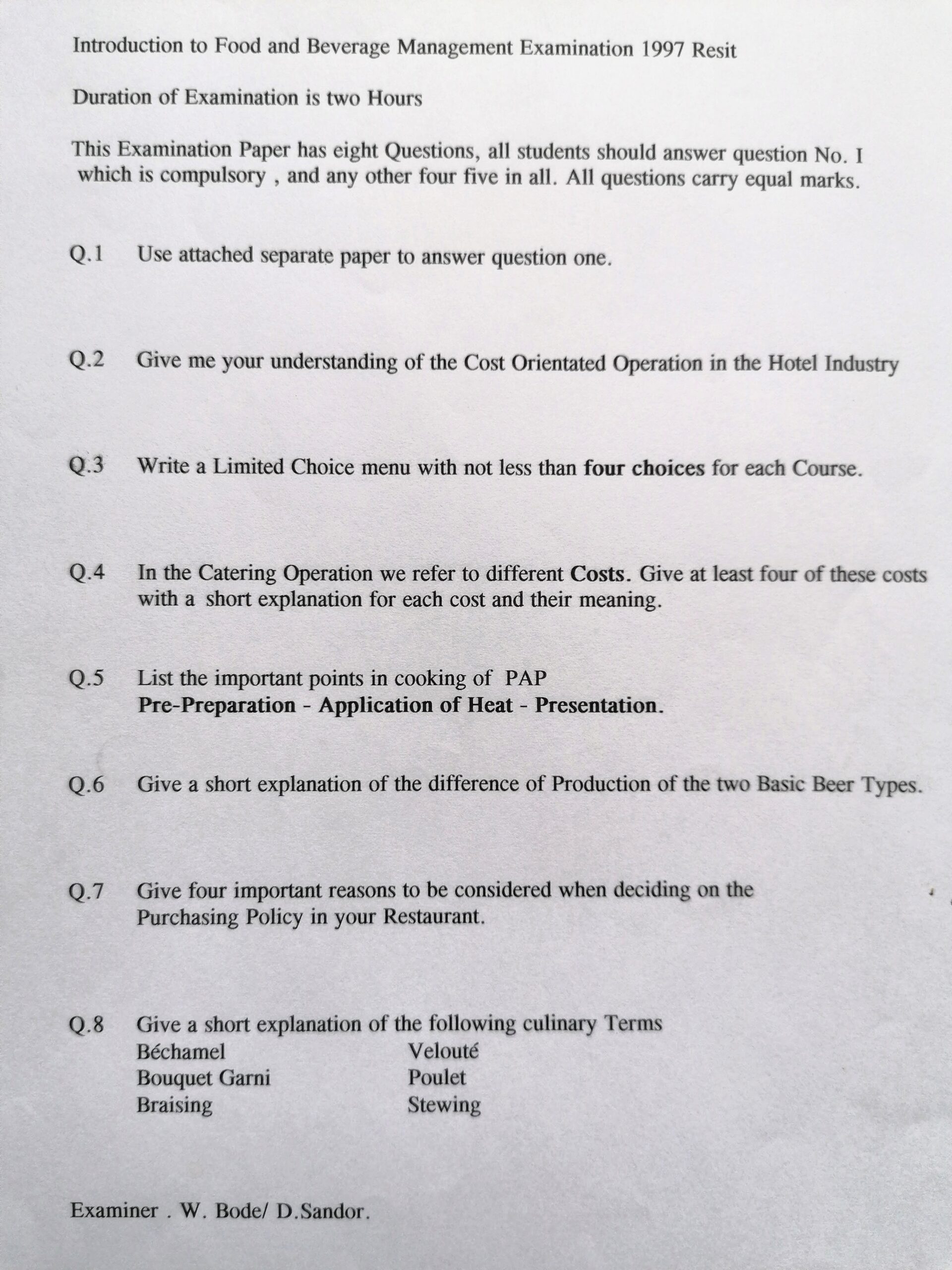
Here are the 1997 Food and Beverage Management exam questions.
*
From 1996 onwards, the Oktató Kabinet annually hosted the national competitions for young chefs organized by the Chaîne des Rôtisseurs, and on one occasion, possibly in 1997, even the world championship. At these competitions, I served as the host chef as well as a member of the kitchen jury. György Salgó was the president of the association, while the professional work was organized and directed by György László, who had previously been the head chef at the Fórum Hotel.
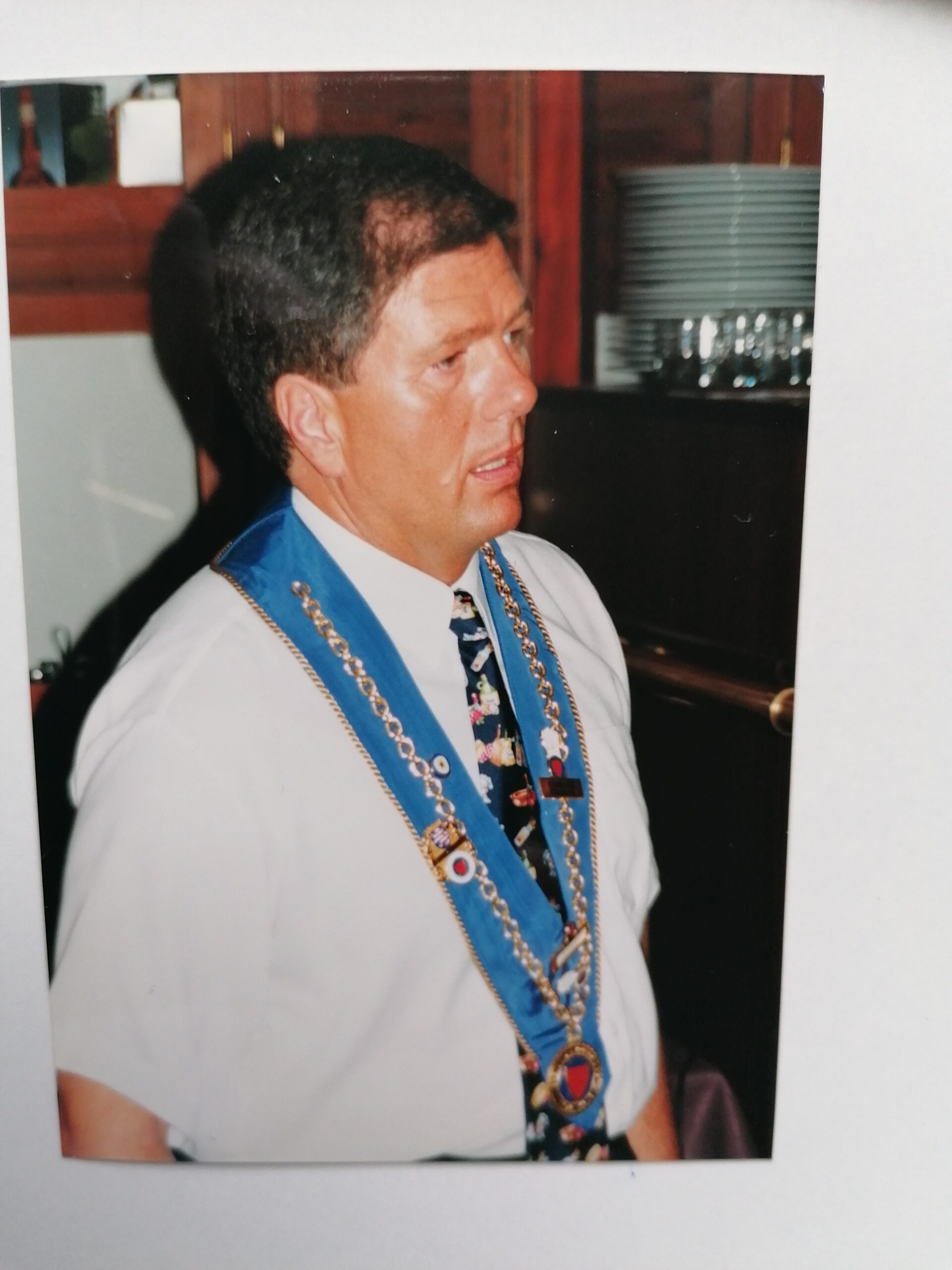
György László, Culinary Arts Advisor, Chaîne des Rôtisseurs Hungary Association, 1998
At the international competition, there was a French observer who silently watched the progress of the contest until it ended and the winner was announced. Then he came over to me, shook my hand, and said, “Everything was perfect, thank you.” That felt really good because we truly paid attention to every detail, and the competition ran smoothly.
Another lasting lesson and exemplary moment for me was how the Australian contestant, about a minute after starting work, had already put away the main ingredients from his two trays into the fridge. His cutting board was covered with a kitchen towel with his knife beside it, and he immediately began preparing the meat. The others were still wandering around, looking for their places in the kitchen, and only started working minutes later. I had introduced the kitchen the previous evening and showed the contestants the usable tools, machines, and equipment. That was the extent of the young chefs’ familiarity with the kitchen before the competition.
The 1998 Hungarian Chaîne competition was won by Lázár Kovács. He and his composition—starter, main course, and plated dessert—are shown in the following pictures.
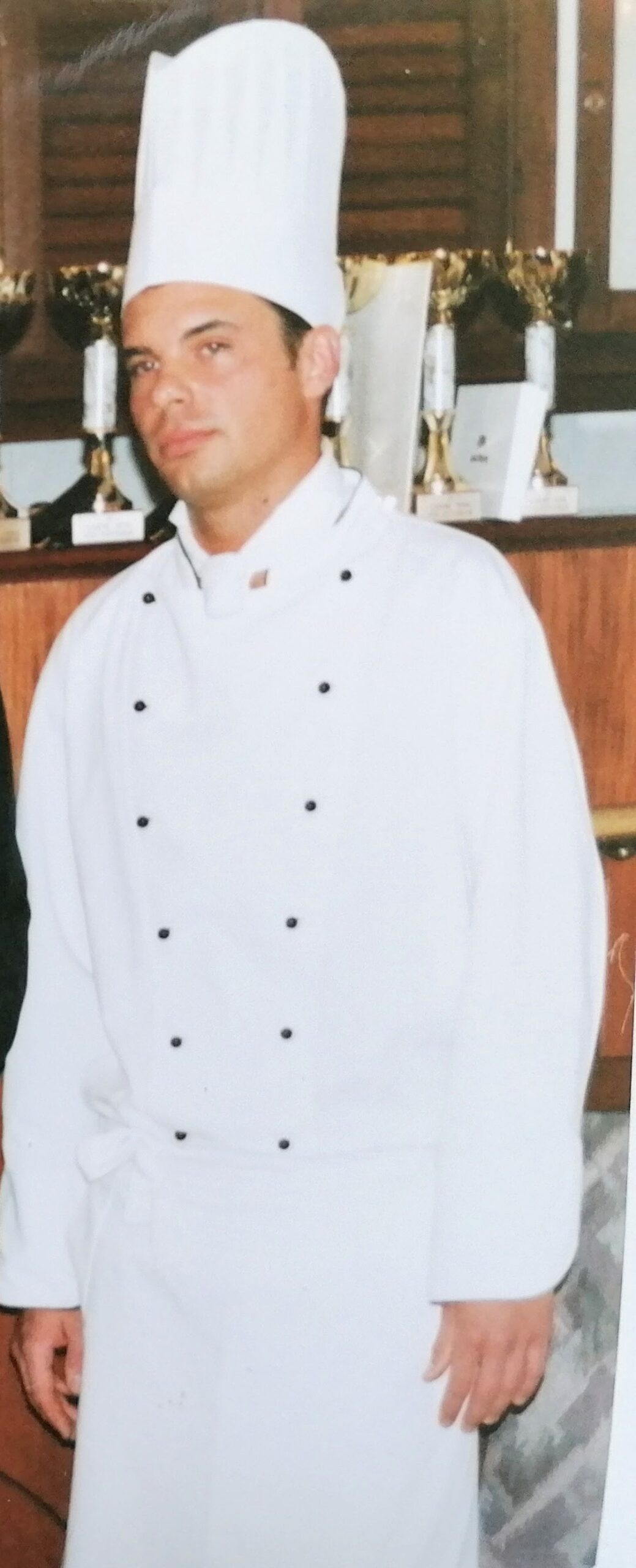
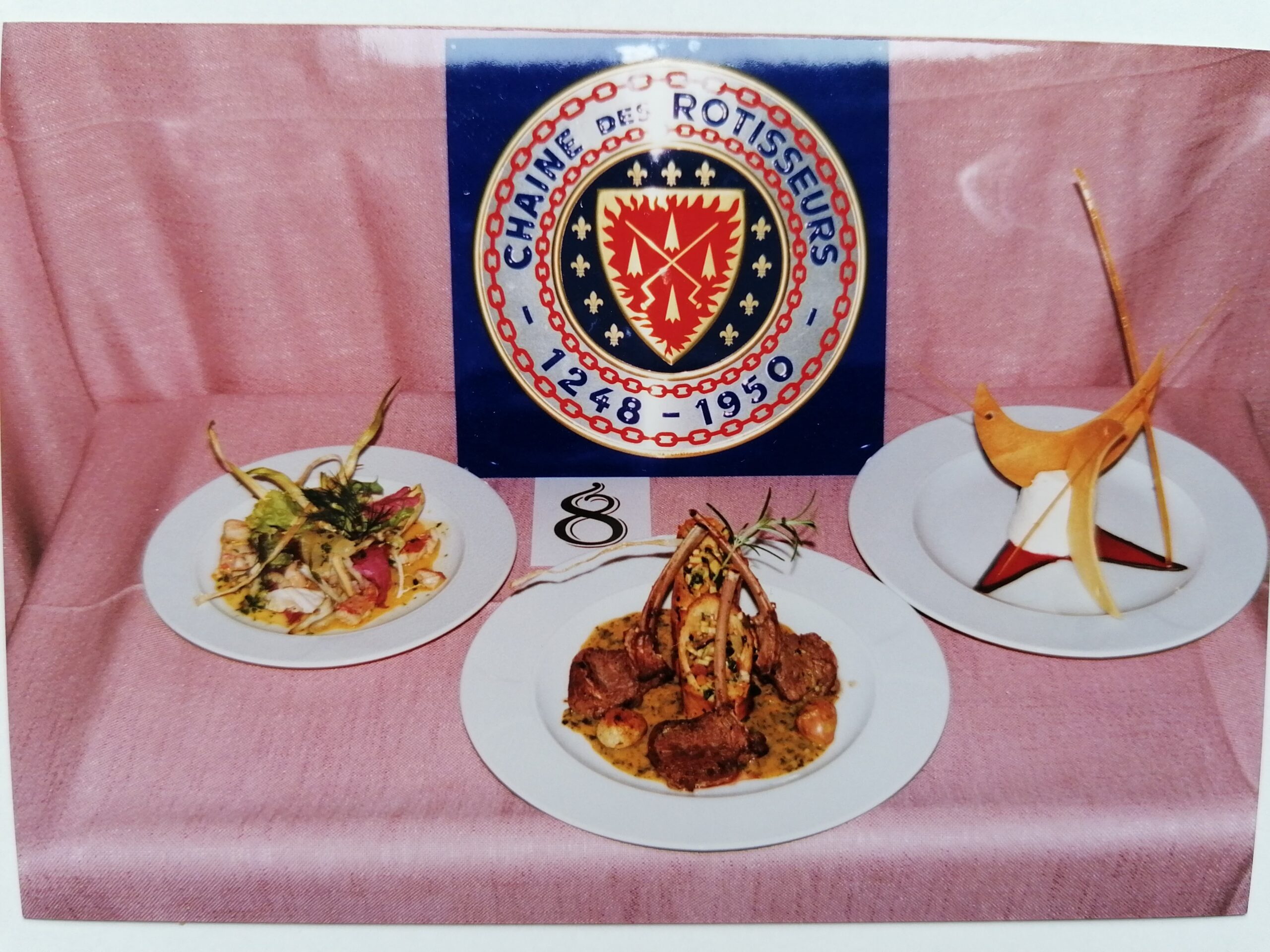
Lázár Kovács and his winning menu at the 1998 Hungarian Chaîne young chefs competition at KVIF
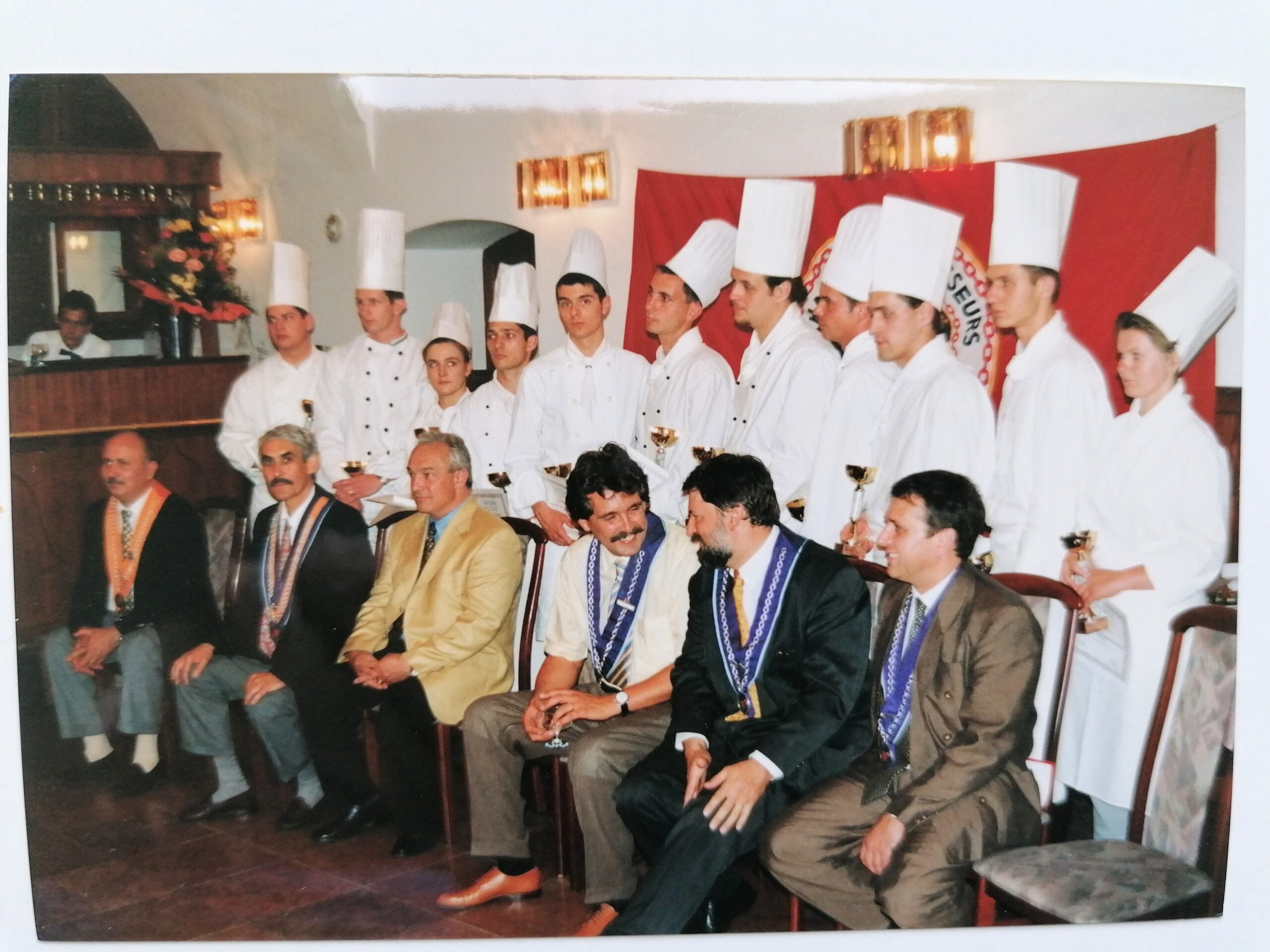
The award ceremony of the 1998 Hungarian Chaîne young chefs competition at KVIF
The following image shows the thank-you letter addressed to me by the Chaîne des Rôtisseurs Hungary Association.
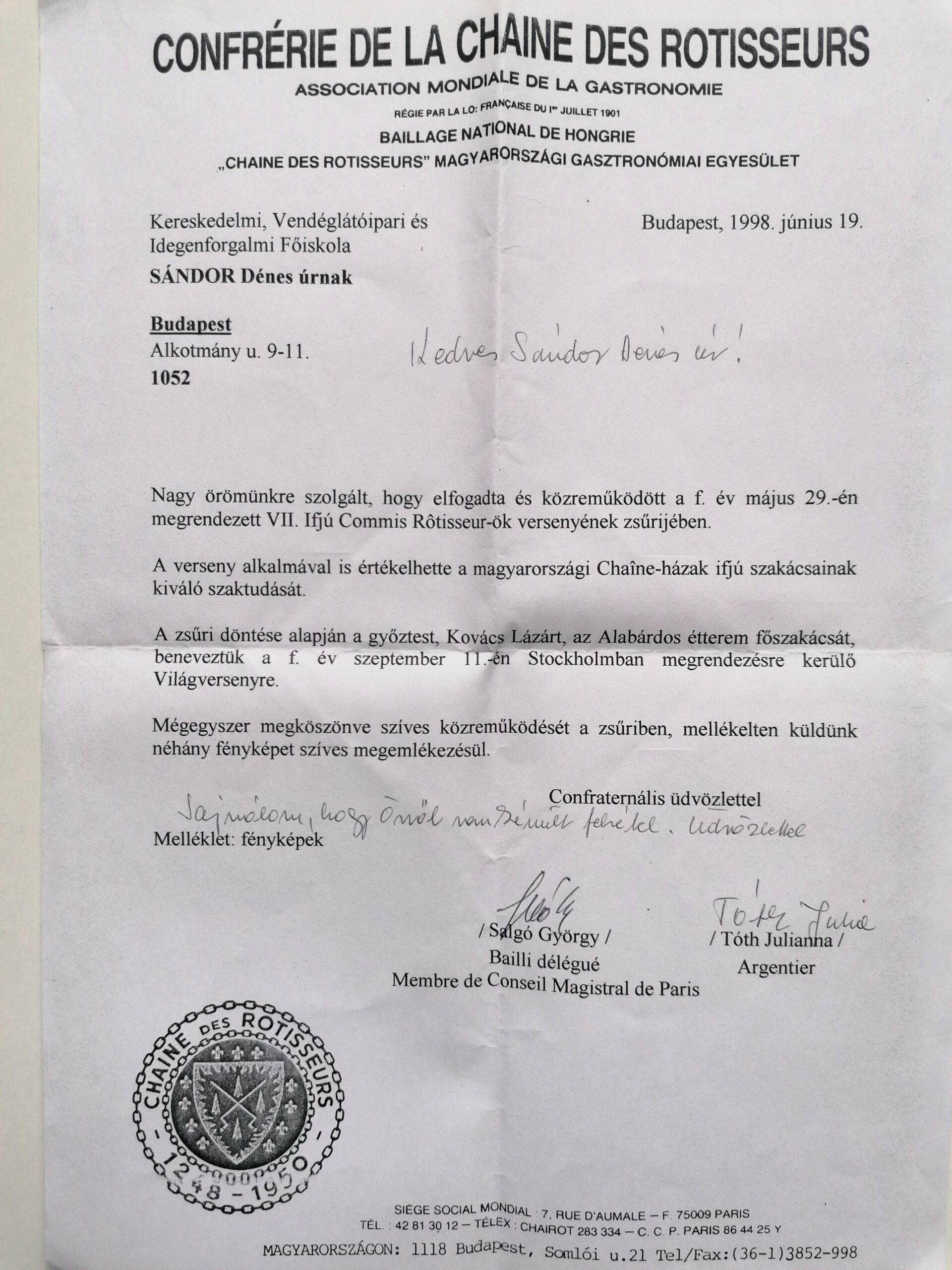
The thank-you letter addressed to me by the Chaîne des Rôtisseurs Hungary Association in 1998.
*
Click on the image to watch the video of “Salmon roasted with spiced butter, served with spinach potato stew” prepared at the Joyful Cooking event! You can find the recipe below the video!
You can watch the interview with Attila Bicsár on YouTube by clicking here.
You can watch the interview with Tamás Lusztig on YouTube by clicking here.
The spontaneous stories shared during the Joyful Cooking event can be found here:
https://youtu.be/6TDPwhLLw9k
https://youtu.be/5X13leUVbxc
https://youtu.be/TE1TnPNx0WU
https://youtu.be/lZ6H6sBpKac
https://youtu.be/zIJjlqrpu5U
https://youtu.be/Onkh7cZqgro
https://youtu.be/pp-Elbby5-c
https://youtu.be/2NXCy2yhwEs
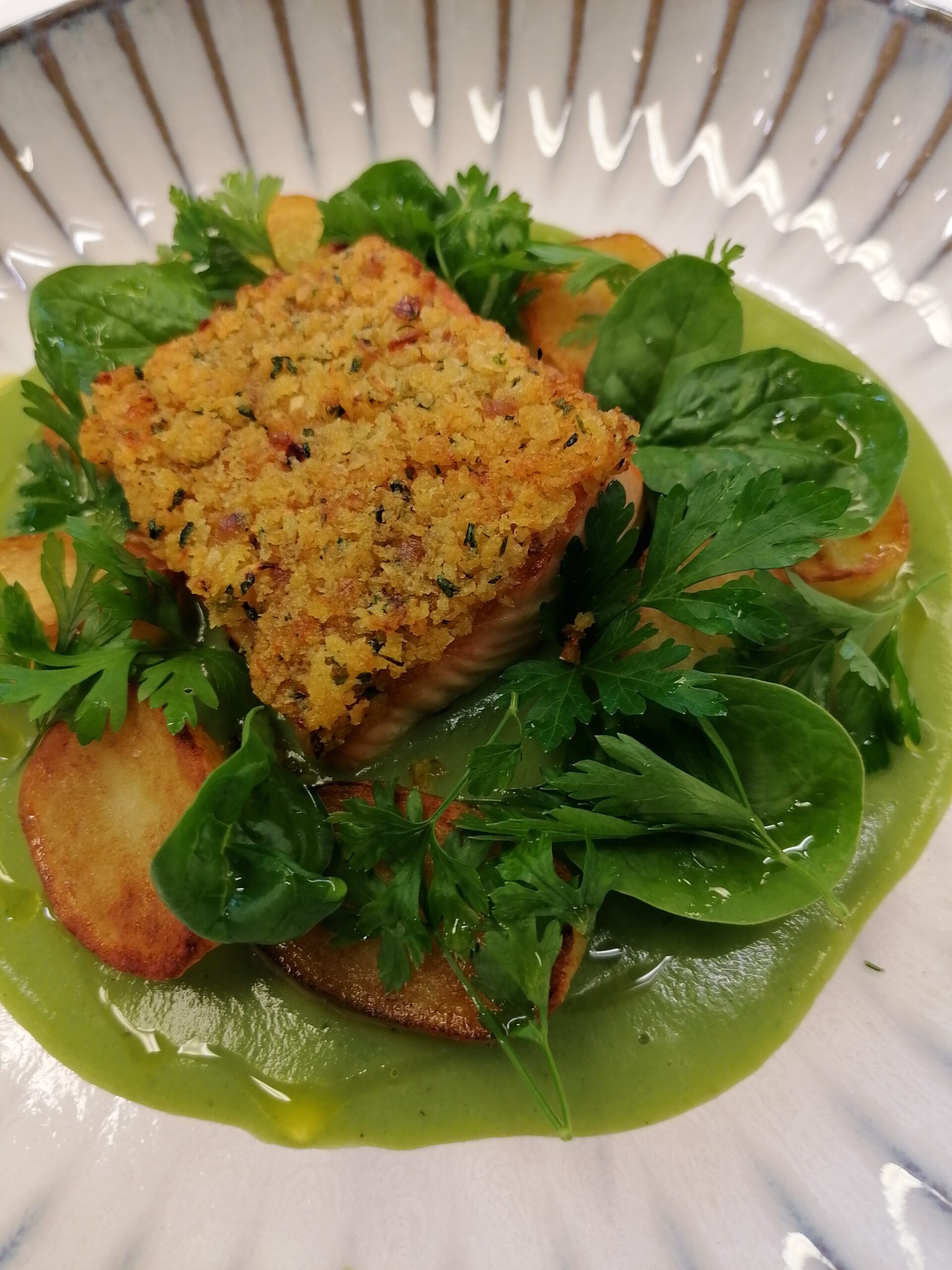
Salmon roasted with spiced butter, served with creamy spinach mashed potatoes
Recommended ingredient quantities for 4 servings:
For the spiced butter:
200 g butter, at room temperature
120 g panko breadcrumbs
3 tomatoes
2 cloves grated garlic
1 small red onion, finely chopped
1 bunch parsley, chopped
salt, pepper
olive oil
For the stew:
0.4 kg potatoes, sliced
240 g small new potatoes
1 head of onion, sliced
50 g baby spinach
vegetable broth or water
2 bay leaves
salt, pepper
sunflower oil
For the salmon:
0.7 kg salmon fillet, with skin
salt, pepper
sunflower oil
Steps for preparation:
- Blanch the tomatoes. Peel off the skin. Cut the flesh into small cubes.
- Sauté the onions in oil. Add the tomatoes and cook briefly, then add the parsley, breadcrumbs, and season with salt and pepper.
- In a mixing bowl, combine the butter with the spiced breadcrumb mixture.
- Using cling film, spread the mixture evenly on a tray and smooth it out. Chill in the refrigerator. Cut into appropriate portions when serving.
- For the stew, sauté the onion in oil. Add the sliced potatoes, salt, pepper, and bay leaves. Fry briefly, then add enough water or vegetable broth to just cover the ingredients.
- Cook until tender. At the end, add the spinach leaves. Remove from heat and blend everything until smooth.
- Meanwhile, cook the small new potatoes. If necessary, cut them in half. Sauté in a pan with a little oil. Season with salt and pepper.
- Remove any bones from the salmon and take off the skin, then shape the fillet. Season with salt and pepper.
- Sear the salmon all around in a pan with a little oil.
- Before serving, place the spiced butter on top and finish cooking in the oven at 200 °C for 4-5 minutes.
- To serve, pour the spinach potato puree in the center of the plate. Place the salmon on it, then arrange the sautéed potatoes around. Garnish with parsley and baby spinach leaves. Finally, drizzle with olive oil.
*
Preview
Work at the College of Catering (KVIF, BGF KVIK) 1992–2004 Part 2.
Joyful cooking with Lázár Kovács, who is a prominent representative of the famous “Alabárdos school,” just like Attila Bicsár featured in the previous part. I have known Lázár for several decades, primarily through the chef competitions held at the college.
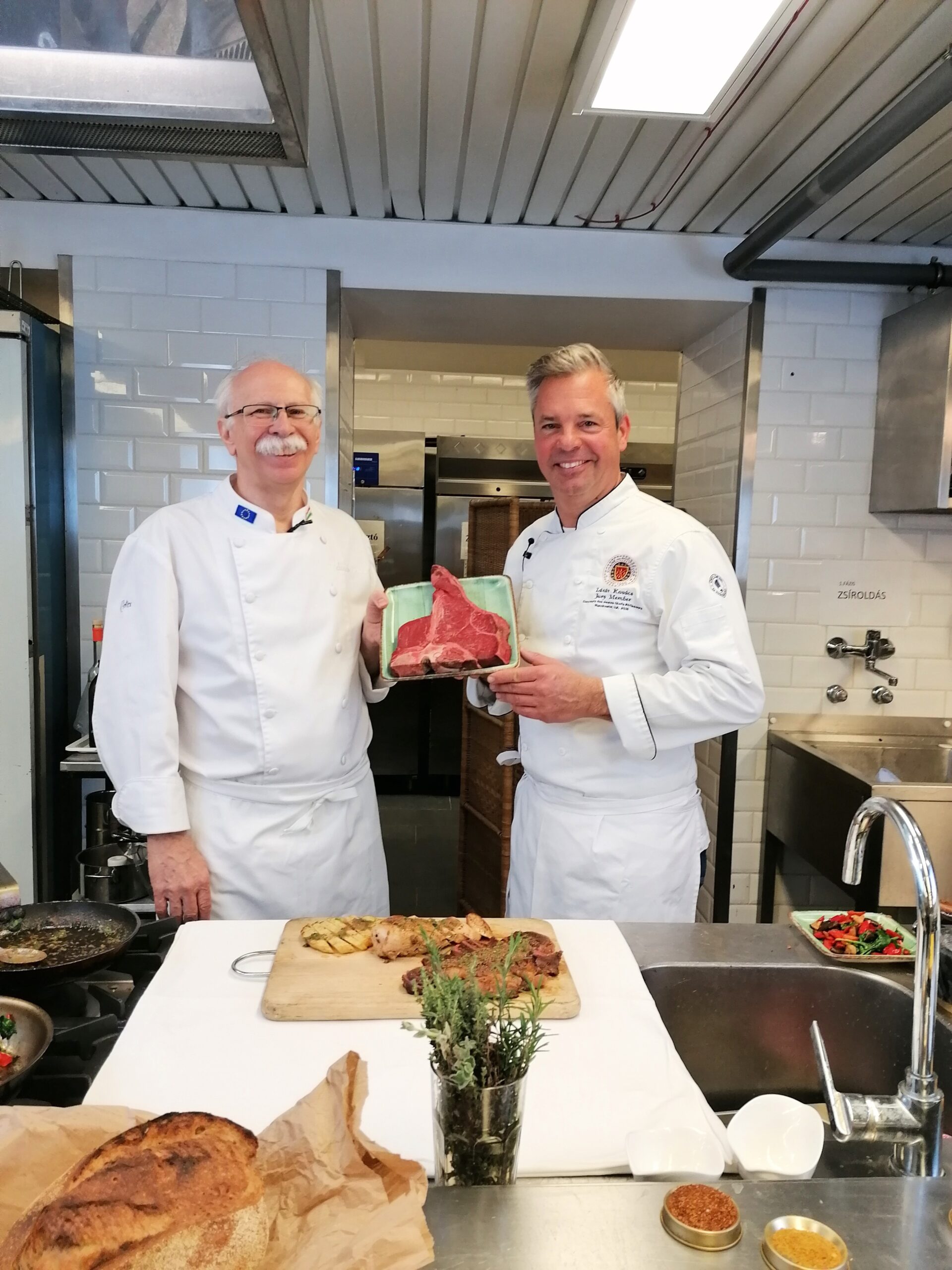
With Lázár Kovács
*