1970-80s Part 1
Studies at the College of Catering (KVF)
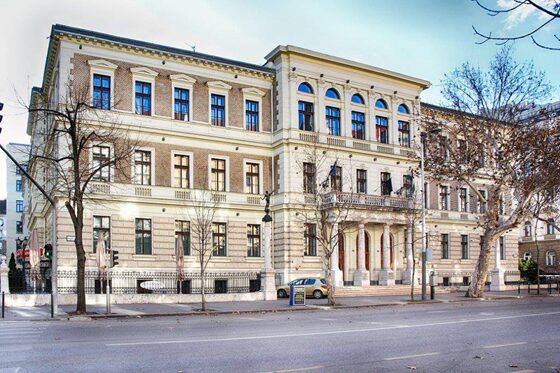
In the autumn of 1977, I began my studies at the College of Commerce and Catering, in the Catering Department, full-time. It was a strange feeling to be back at school again—attending classes, participating in practicals, and listening to lectures. The Food Preparation Practicals were divided into three areas: Hot Kitchen, Cold Kitchen, and Confectionery. In the hot kitchen section—which was in the main kitchen where cafeteria meals were also prepared—the chef, Zsolt Haág, quickly assessed the situation and, realizing that I had ten years of experience in cooking and baking, entrusted me with the instruction of my own small group. The dishes were prepared on three available household stoves, and after plating, the chef evaluated and graded them.
The cold kitchen knowledge was taught by László Marczinek. Confectionery was a new field for me, despite having had the opportunity to make some basic pastries before. The head of the confectionery production and also the instructor in this area was Imre Nagy, a traditional craftsman without a higher education degree. The lack of such a qualification was considered a serious issue by the college administration, especially when the head confectioner would shout and throw objects around the workshop.
This issue—namely, whether an instructor had a higher education degree—continued to follow me throughout my later teaching career. Whenever I invited an external instructor to teach food preparation practices, I had to bear the burden of this problem. Still, I always considered the professional excellence of the guest instructors more important than their formally required academic qualifications.
During the laboratory practicals, we learned about the physical, chemical, and sensory (organoleptic) properties of foodstuffs and ingredients, performing measurements accurate to a tenth of a mg/ml.
*
During the lectures, the entire class of 120 students would take their seats in a large lecture hall and listen to the lecture on the given subject—such as mathematics, technical knowledge, economics, food preparation knowledge, etc.—delivered by a subject leader. The latter subject was taught by college associate professor/principle lecturer Pál Vajda, who introduced us to the colloid chemical properties of foods. There was little to no mention of the foods themselves or their preparation. Of course, knowing that our lecturer had graduated as a chemical engineer from the Technical University made the material more understandable. I had mixed feelings about this. On one hand, I found it strange that food preparation and types of dishes played almost no role in the curriculum. On the other hand, it was valuable to gain insight into the invisible background processes of food preparation.For example, the aging of bread: syneresis, which is a reversible process, meaning it can be undone by heating. Similarly interesting is the colloid chemical definition of mayonnaise, which is an o/w (oil-in-water) emulsion. In this, the low pH, acidic (lemon juice, mustard) aqueous phase gradually receives the oil in small quantities with continuous mixing, and by the end of the process, the emulsion is able to form a thick, homogeneous (uniform) sauce, even though oil makes up 90–95% of the entire mixture.
*
The seminars were classes held for groups of 30 students, ideally intended to process the information presented during the lectures, and theoretically, the sessions could be interactive.
As part of the foreign language instruction, I studied English and Russian (which was mandatory). I liked English, especially because of the extra assignments. In addition to the required material, our teacher, Anna Kéri, brought in things like the lyrics and music of Jesus Christ Superstar, which we analyzed. Russian was more of a struggle, although our teacher, Mrs. Funk, made every effort with boundless patience to teach the basics of the Russian language to our small group. In the end, after a lot of practice and studying, based on my results at the end of the third year, I managed to earn a grade equivalent to a basic level Russian language exam.
*
I took on demonstrator work at the Department of Nutrition Science. During this, I helped with departmental tasks for a few hours each week, such as preparing raw materials and tools for laboratory practicals, performing administrative work, and even participating in the department’s research activities. A large-scale study was underway involving several departments on “Large Kitchen Baking and Cooking Equipment,” in which we examined the operation of the devices available on the market at that time, conducting energy measurements and optimizing heat treatment times and temperatures both at the College and in external large kitchens. Using the research results, Dr. Tivadar Szűts, who was the head of the Department of Catering Organization, prepared his candidate dissertation.
On the recommendation of Professor Dr. Károly Lindner, head of the Department of Nutrition Science, I examined the quality of various types of pork (PSE—pale, soft, exudative, and DFD—dark, firm, dry) under the influence of heat treatments. Due to the novelty of the topic and the way it was processed, this primary research earned me wins in local college (KVF) and national higher education Scientific Student Competitions.
*
Among my classmates, quite a few—myself included—had already come to the college full-time with sometimes several years of work experience. One such was László Bangó, who studied at the vocational school in Keszthely and with whom I completed the chef school together in 1971 at a national competition in Sopron. The age of my classmates ranged between 18 and 23 years, and when we add the differences in work and life routines, we formed a healthy mixed group. Among the younger students, many had completed high school and consistently studied diligently, similar to their high school days. Some of the more experienced students and those who took their training less seriously were regulars at the so-called Szalay Department (pub).
*
Among my group mates, Péter Balló and I were particularly close and became friends. Péter often came over to our place. Sometimes we studied together, preparing, for example, for the Nutrition Science exam, including the citrate cycle, also known as the Szent-Györgyi-Krebs cycle. Other times we played cards and chatted. His father was the technical director of the Hilton Hotel, and thanks to that, we were able to tour and study the hotel building inside and out. It was interesting to see the water tank on the hotel’s roof that supplied the hotel’s water, the generators that activated during power outages, the industrial ironing machines (calenders) suitable for ironing bedding, and the pneumatic tube system, which allowed documents to be sent, for example, from the secretariat to the head chef’s office and back. We also rode on top of the guest elevator while guests were getting on and off. We timed this visit just before the Technical Knowledge exam. During the exam, I managed to weave some of these experiences into my answers.
*
At the college, there was the Gourmet Club, through which we organized various dinner evenings showcasing mainly regional—domestic and international—cuisines. This club operated with about 15–20 students; we could say that it was here that students with professional experience showed enthusiasm and proved themselves. It was considered an elite club in the sense that those who had graduated from a “regular” high school found it difficult to get into this group.
*
Among the teachers, quite a few taught exceptionally well, and within that group, some did so in subjects that were fundamentally close to me or that I came to appreciate only because of the way the lecturer presented the material. Such was Dr. Lajos Kádas, who gave lectures over several semesters on nutrition science; or dr. József Király in the subject of hospitality psychology, who in his one-and-a-half-hour lectures referred almost every minute to some interesting psychological experiment; and Miklós Horn, who once substituted and gave a lecture in economics on the theory of surplus value (Mehrwertsteuer). I remember these excellent teachers and their high-quality lecturing style with respect and joy to this day.
*
A commemorative volume was prepared in 2019 for the 50th anniversary of the college, from which I quote two more aspects related to my studies.
One concerns how, alongside my college studies, I often worked part-time: “Our family needed income to survive, so I regularly worked part-time in the afternoons, evenings, and on weekends. I primarily worked as a waiter because I thought that I already knew the kitchen well enough, and now it was time to get to know the other side of the serving counter. I attended classes at the college with enthusiasm, but on Friday and Saturday evenings, as well as during the day on Sundays, I worked as a waiter at the BM Club located in the Danube Palace. I spent my one-month summer college internship in 1978 at the Hilton Hotel kitchen. From 7 a.m. to 3 p.m., I was in charge of the Coffee Shop restaurant kitchen. From there, I literally went to the BM Club, and as described above, worked in the restaurant from 4 p.m. to midnight, sometimes later on Saturdays.”
The other concerns humorous moments for me: “There were, of course, funny moments at school, such as when Dr. István Hajdú, on his very first lecture, spoke at length about the scarcity of available time, and that filled the entire class. Another story is when dr. Miklós Gábor presented the previously written midterm exam results in economics. He walked back and forth between the desks for five minutes, then said, ‘I could accept one exam,’ and several students started feeling uneasy. After another five minutes of pacing, he said, ‘I accepted three more exams because I listened not to my mind but to my heart.’ In the end, out of 30 students, I fell into the category of ‘accepted, but suggested to write a make-up midterm.’ Finally, when historian Tamás Krausz came to his first lecture, he asked us, third-year students, ‘Is there anyone here who has graduated from high school?”
*
I successfully completed my college studies in 1980 and became a Hospitality Operations Economist. During my school years, I signed a contract with the Pannónia Hospitality Company, according to which they would pay me 500 Ft per month, and I would work for them for two and a half years after graduation. Accordingly, I started working in the Inspection Department in September 1980. Madarászné—who was the wife of the famous pastry chef Sándor Madarász—assigned the operational tasks as the team leader. I performed “serious” professional work, as I had to go out on night inspections to various nightclubs and check their liquor inventories. For example, with a poker face, I entered the dancers’ dressing room amid some screams and stood by the drinks in the fridge. The college wanted me to work there instead, so Dr. Tivadar Szűts, head of the Hospitality Department, and Jenő Somogyi, general director of the Pannónia Hotel and Hospitality Company, agreed to waive the repayment, and I could start working at the college. Moreover, Professor Kádas offered that after one year I could become an assistant lecturer at the Department of Food Science. Thus, already in December 1980, I was working as the sous chef in the college kitchen.
Hospitality College (KVF) Work 1980–1991 (Part 1)
I worked at the College of Commerce and Hospitality (KVF), later KVIF, BGF KVIK, BGE KVIK from 1980 to 2017 for 37 years.
My recall to the college may have been influenced by my demonstrator work and Scientific Student Conference results and/or by the fact that during this time the department staff got to know me better. I performed the large kitchen work under the direction of Chef László Marczinek. It was a bit strange to work full-time in the kitchen again, but I had the opportunity to advance to the department, so as always, I did my work with full commitment. After a few months, I was appointed head chef.
*
Again, after a few months, I was taken for military service. Considering my two little daughters, it was “only” for one year. I spent these 12 months at the Zách Street Supply Center. After one month of training, I was appointed as a cook instructor, of course without pay. I was lucky because I could go home every day; I only had to be back at the barracks by six in the morning. One early morning, in the last moment of dawn, I noticed a major coming toward me, so I was able to salute him. I requested an eye exam and received glasses with a minus one prescription. On another occasion, I gave a theoretical lesson to about 30-40 soldiers, and as usual, I told them a story related to cooking, which made them burst out laughing loudly. Shortly after, the door opened, and a professional officer appeared from the next classroom; he was also holding a lesson— a silent lesson— for another group. “What’s going on here?” he asked. “Nothing, just giving a lesson,” I replied. Then he turned around, closed the door, and returned to his own room. At that moment, my group and I acknowledged with “silent” laughter that nobody was punished for the incident.
*
As I returned to the College in 1982, I was finally able to work as an assistant lecturer at the Department of Food Science. At that time, I was 28 years old. Basically, I worked alongside Pál Vajda, who was responsible for the subject of Food Preparation. On the one hand, I helped him with administration, and on the other hand, I conducted practical food preparation classes for college students in the kitchen. Around that time, György Haris attended the full-time program and was participating in the cold kitchen practical, where he had to prepare a Niçoise salad. It was already clear then that he “was not new” to kitchen activities, as he requested black olives alongside the green ones and moved around the kitchen quite skillfully. Pál Verebes attended the evening program, later becoming my colleague at the college, and entertained his fellow students with his good humor during the kitchen practicals.
*
I really enjoyed working at the department; everyone was helpful. The head of the department, Dr. Károly Lindner, did not really take part in the operational work, but that was hardly necessary because every subject coordinator carried out their duties expertly. The heart of the department was Marika Zubor, the administrator, who supported the precise execution of administrative tasks with her good nature and great knowledge. My work schedule was also optimal since, unlike classic kitchen work, there was no need to work weekends or evenings at the department, and I only held one or two practical sessions a week. Moreover, I had the opportunity to take one working day per week as a research day.Besides the official tasks, my colleagues dr. István Hajdú, Pál Vajda, and I would sit down once or twice a week at the department and casually discuss current professional, educational, and any other topics over a cup of tea or coffee. Unfortunately, this inspiring, humor-filled activity ceased permanently after a few years due to lack of time.
Other instructors at the department included Dr. Lajos Kádas, who taught Nutrition Science; dr. Andrásné Seregi, Eta, who taught Food Chemistry. Later, dr. Teréz Ladocsi joined the department, teaching Food Chemistry, and dr. Katalin Schmidt, who taught Microbiology and Hygiene.
*
From around 1987 — when Pál Vajda retired — I became responsible for the subject of Food Preparation. I had to handle everything related to the subject, starting from the curricula and the designation of mandatory and recommended literature, to compiling, administering, and grading midterm exams, organizing colloquiums and conducting exams, as well as delivering lectures and fully organizing the practical sessions. For the latter, I always invited external lecturers to conduct the kitchen practicals, such as Károly Gyarmati and László Dankai, who were the head chef and sous chef of the Erzsébet Hotel, or Andrást Molnár, who had previously worked for a long time in Japan. Since they came from the profession, continuous external control and quality assurance of the education were ensured.
*
Besides teaching, we complemented our work with research and publication. Among the departmental research projects in the 1980s in which I participated, the examination of pork quality was already mentioned. Other research topics included “The Use of Soy in Human Nutrition,” “The Kitchen Technological Usability of Flaxseed,” and “The Edible Use of Alcoholic Extracts of Various Spices and Herbs.” In these studies, I investigated the culinary applicability of raw materials. After soaking, soy granules were used to prepare numerous dishes, such as meatloafs and fillings. It was fully suitable for certain dishes, although its distinctive taste somewhat disturbed the overall flavor for me.
We also tried using flaxseed in cooking, not only as a topping. Our greatest success was an ice cream whose flavor and texture resembled that of hazelnuts.
The spice extracts are thanks to my colleague dr. Teréz Ladocsi, who prepared extracts from various spices as part of her own research. The values of the extracts, made at low temperatures, were preserved by avoiding high-temperature cooking. This led us to various ice creams. The ice creams produced under laboratory conditions were then made in larger quantities by Tibor Kocsis, the head pastry chef at the Erzsébet Hotel—which served as the teaching hotel of the college from 1987 onward. Cinnamon, clove, and “Herbária,” which contained extracts made from various green herbs, were true hits. These ice creams, besides containing only natural flavorings and colorings through the extracts, represented top quality. There was business interest in the extracts as well, but they never reached the market.
A promising primary research project regarding sous-vide in the mid-1980s unfortunately did not come to fruition. Around 1983, a French expert gave a lecture about sous-vide technology at the Intercontinental Hotel and explained that half of the French railways’ hot meal supply consisted of sous-vide foods. I enthusiastically presented this research opportunity to the then head of department, Dr. Lajos Kádas, adding that the necessary equipment cost 60,000 French francs, about 300,000 Hungarian forints. I received a negative response. However, from the mid-1980s, I already incorporated this then little-known topic in Hungary into my lecture materials.
*
My publications up to 1991 were the following:
1. Raw materials and recipes of the natural kitchen (editor) | Agricultural Publishing House 1987 |
2. Use of a microwave oven | Women’s Magazine 1987 |
3. Planetary recipes | Agricultural Publisher 1987 |
4. Planetary recipes | Agricultural Publisher 1988 |
5. Hot kitchen food knowledge notes | College of Commerce and Catering 1989 |
6. Drinks from A to Z (reviser) | Agricultural Publisher 1989 |
7. Baking and cooking in the microwave (editor) | Talentum Ltd. 1989 |
8. Easter dishes | Hungarian Radio 1989 |
9. Step-by-step cooking (specialized editor) | Agria Publisher 1990 |
10. What you need to know about wine | Culinary Art 1990 |
11. From the noble words of our familiar flavors | Private Publisher 1990 |
12. Breakfast drinks | Hungarian Radio 1990 |
13. Basics of diet and public catering (co-author) | College of Commerce and Tourism Continuing Education Ltd. 1991 |
14. Food is the best medicine (editor) | Fine Arts Publisher 1991 |
Internal corporate professional materials
1. 100 Old Hungarian Food Recipes (reviser, compiler) | Danubius Catering Company 1987 |
2. National Catering Competition (specialized editor) | ORI 1988 |
3. Recipes made from flax | Len-Budaflax 1988 |
4. King Matthias’s Kitchen | Application Material 1988 |
5. Wine Presentation (specialized material compiler) | For Hugh Johnson 1990 |
The list of food recipes from the first item in the corporate materials can be seen in the following image.
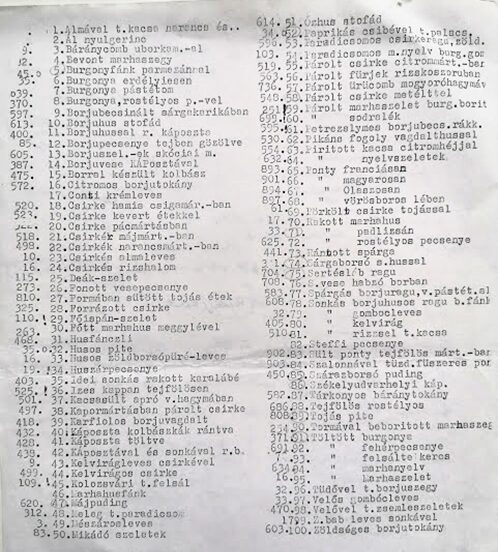
List of 100 old Hungarian recipes
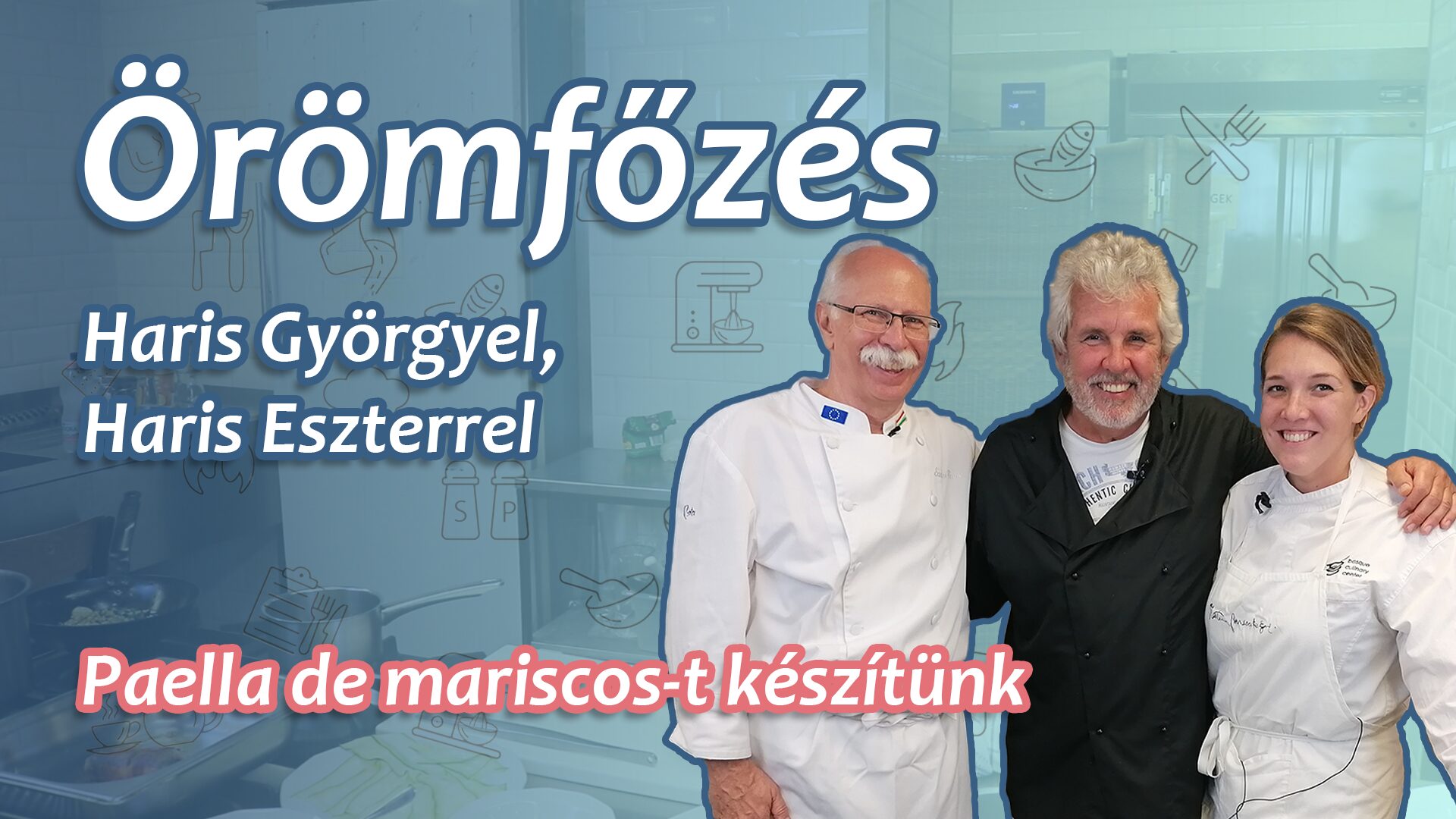
Click on the image to watch the “Paella de mariscos / Paella with seafood” video made at the Joyful cooking event! You can find the recipe below the video!
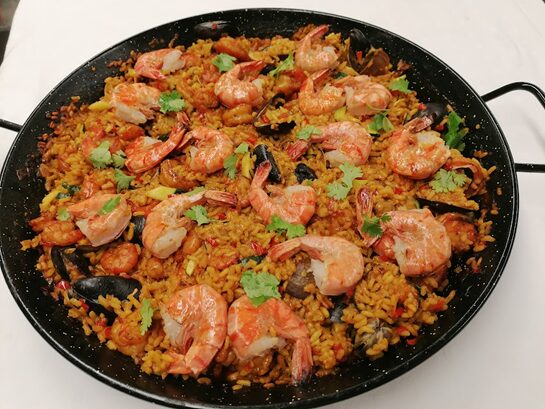
Paella de mariscos / Paella with seafood
Recommended ingredients for 10 person:
For the paella:
olive oil
0.5 kg raw shrimp tails (26/30 count)
1 large onion
4-5 cloves garlic
1 each red, green, yellow bell pepper
100 ml white wine
smoked paprika powder
100 g tomato
salt
0.5 kg raw, peeled shrimp tails (31/40 count)
0.8 kg round-grain rice (paella or arborio)
1.5-2 liters fish stock
0.2 kg black mussels
0.2 kg small Venus clams, pre-cooked possible
1 zucchini
pepper, saffron, or colorante use optional
The preparation steps:
Clean half of the larger shrimp tails.
Heat the oil in the paella pan and fry the larger shell-on shrimp tails, then remove and set aside.
Fry the shrimp shells as well, then remove and set aside.
Sauté the finely chopped onion and garlic until translucent, then add the diced colorful bell peppers, sauté, pour in the wine, let it evaporate, and sprinkle with smoked paprika.
Add the peeled and seedless diced tomatoes, salt, then add the raw smaller and larger shrimp and the black mussels.
During cooking, add the rice and after stirring, pour in the stock to cover it.
While continuously simmering, add more stock and the Venus clams.
When the rice is half-cooked, add the chopped zucchini.
Finally, cook covered with aluminum foil until done; you can slightly crisp the bottom — as the Spanish like it — or prepare it with a risotto-like consistency.
Serve the dish in the paella pan used for cooking, garnished with the fried shrimp tails and fresh coriander.
Preview
1970-80s Part 2.
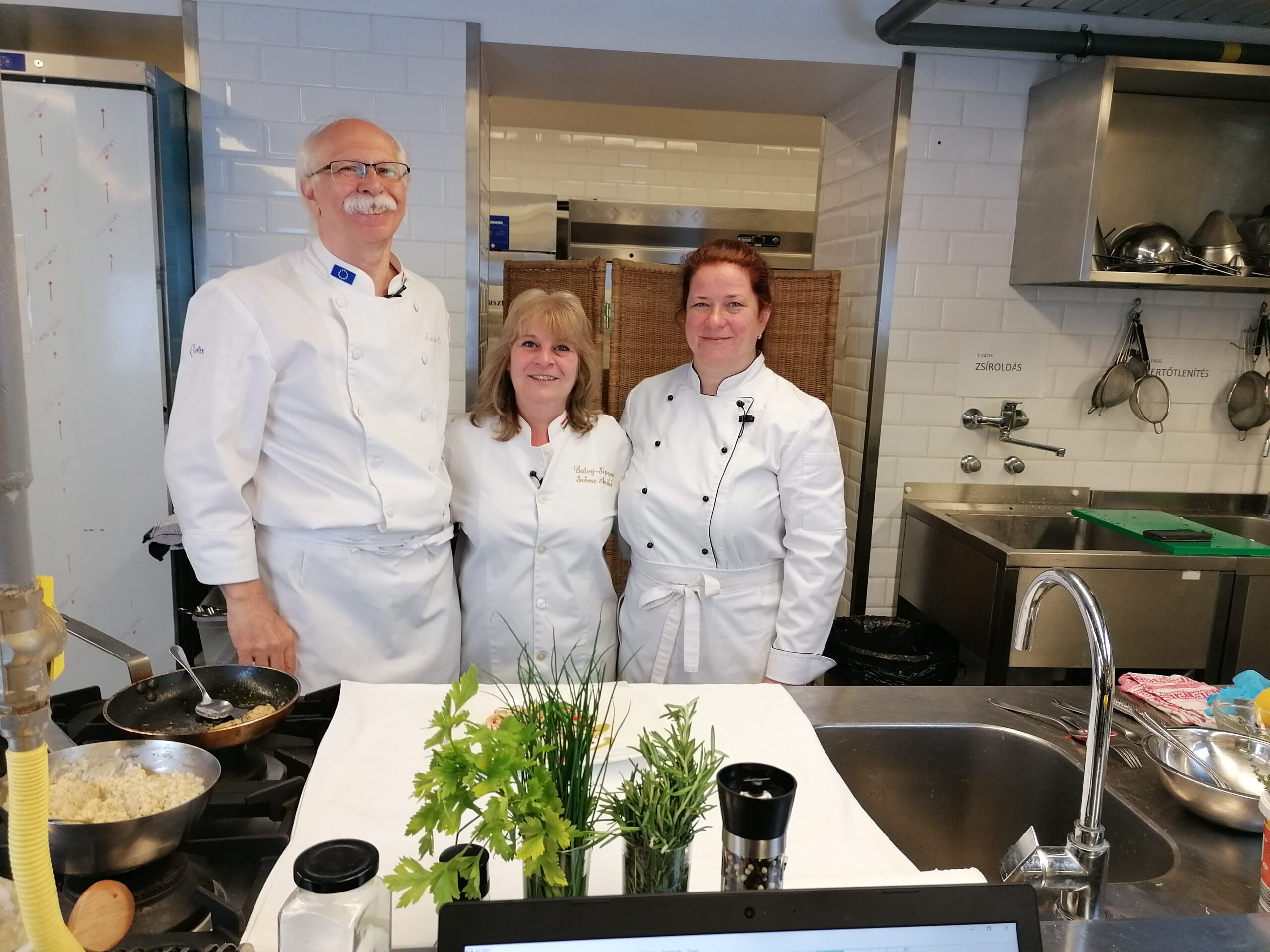
Joyful Cooking sessions with Anikó Balog-Siposné Szőcze and Hedvig Hidvégi, who were my colleagues at the college, Ancsa since the second half of 80s, Hédi since the beginning of 90s.
With Anikó and Hédi