Hospitality College work 1992-2004 Part 2
From the mid-1990s, another notable series of events was the demonstrations by French chefs organized by Sopexa. The Hungarian director of the French company, Gabriella Szlávik, managed the tasks in a professional manner, and I gave her my full support because “knowledge came to our doorstep.” Of course, such events meant extra work for my colleagues and me, but it was a joy to see and hear, for example, Patrick Pages, a two-Michelin-starred chef (Chantoiseau restaurant, Vialas), who visited us several times and provided both theoretical and practical training to the then forward-thinking young Hungarian cooks and chefs. These demonstrations lasted several hours a day, over a shorter or longer period (1–5 days), and there were occasions when the participants, applying what they had learned, even competed on the last day of the event.
On one occasion, I cooked a leek cream soup for Patrick, which at the time was fashionable in Hungary, though of course it had nothing to do with French onion soup, but I was curious to see how he would like it. He started eating, then asked if he could have bread with it, and whether he could dip the bread into the soup. I said, of course, make yourself at home.
There were times when Patrick sent his deputy, Thierry, to give a demonstration for us. The young sous chef showed off his fantastic skills and, for flambéing one of the dishes, asked for some white wine. He poured the wine into the pan over the dish, heated it, then set it alight. The flames burned with huge intensity for a long time, and he remarked appreciatively that we had really good quality wine. The Hungarian participants, keeping poker faces and stifling our laughter, nodded along. The “wine” was one-liter “cooking wine.”
Patrick Pages considered the demonstrations in Hungary a mission, and this also included inviting the winner of the competition, Lázár Kovács, to his restaurant for a study trip.
*
Thanks to these international competitions and demonstrations, the college’s training kitchen became a benchmark for young, enthusiastic Hungarian cooks eager to learn, because it offered the opportunity to acquire authentic professional knowledge. I was happy to serve as host and/or jury member at these events. Overall, this prosperous period, which set many Hungarian talents on their path, lasted 25 years (1992–2017) with my involvement.
*
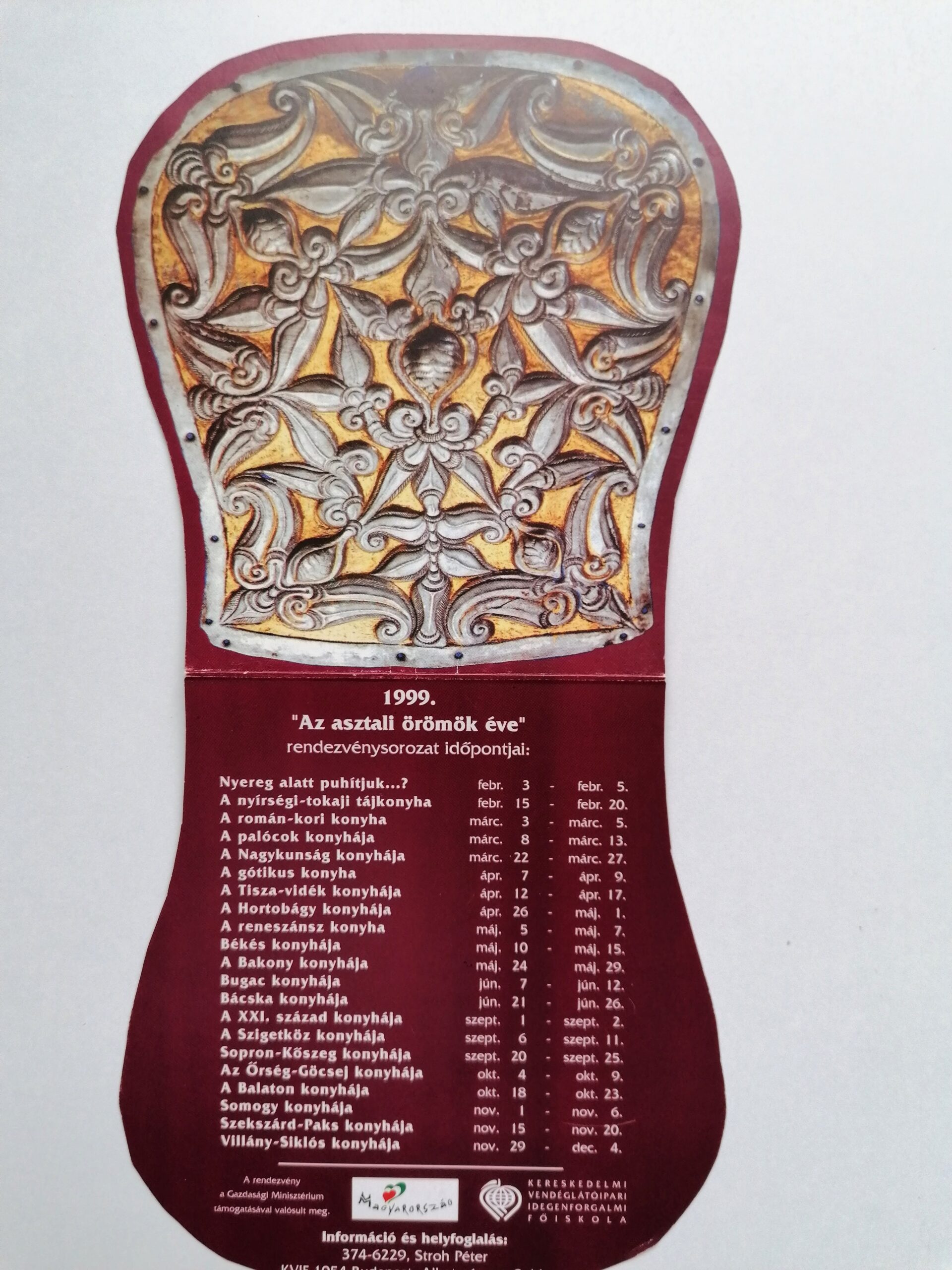
In 1999, the “Year of Table Pleasures” was a highly successful series of events held throughout the entire Alma Mater and the Teaching Cabinet at KVIF. Two photos show the menu cards from the gastronomic dinners presenting historical and regional Hungarian cuisine.
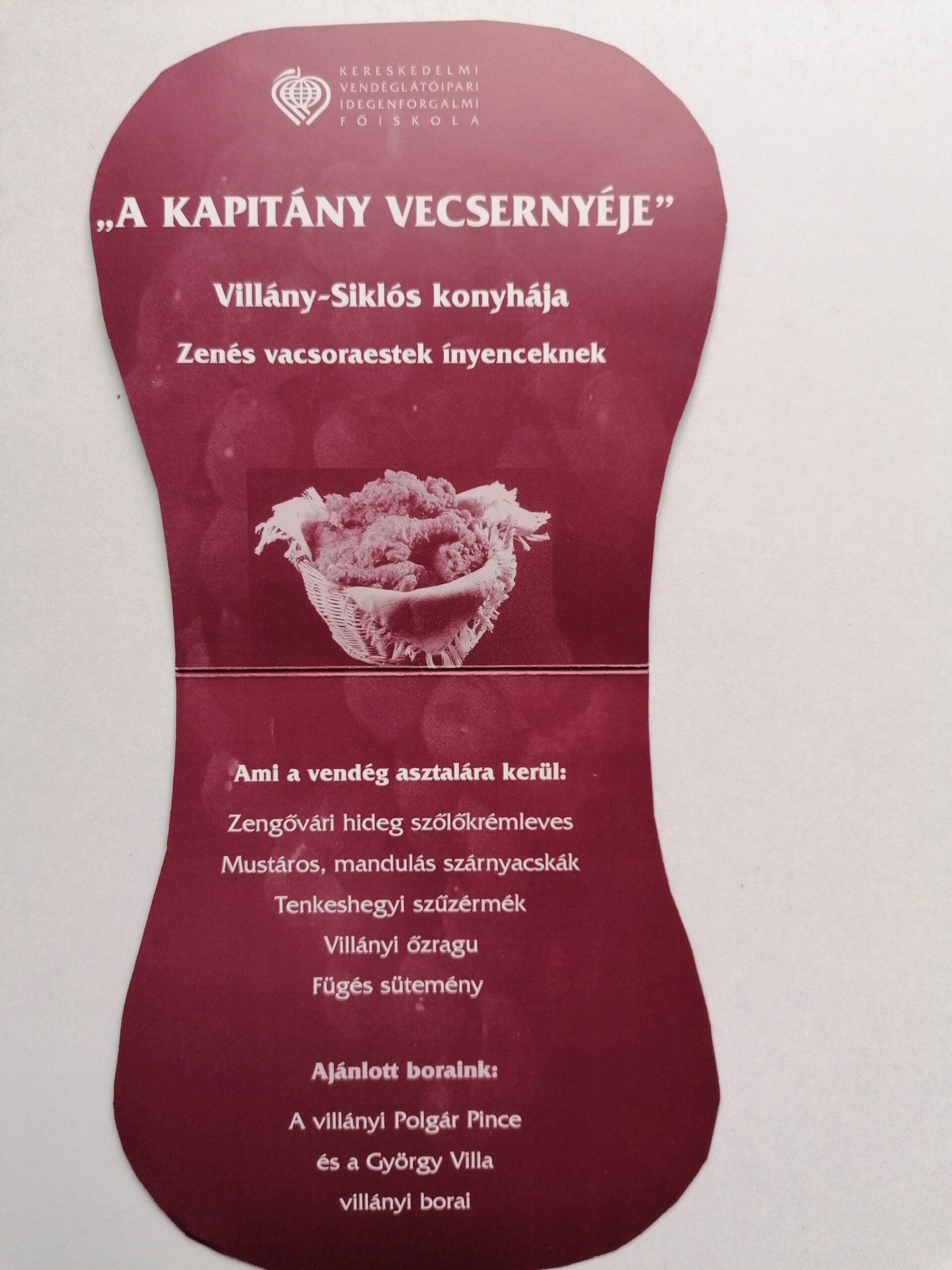
“The Year of Table Pleasures” event series in 1999 at KVIF
*
Around 1999 (give or take a year or two), I wanted to surprise my best students at the time for Christmas, so on December 22nd I held an extra cooking demonstration for them. After some preparations, in 70 minutes, using 8 stoves and one oven, I prepared and plated 10 dish components for tasting by the 15–20 participants. Both cooking skills and logistics played an equally important role.
You have to imagine that I started cooking with the dish that took the longest to prepare, which, if I remember correctly, was a consommé made with stock. This was followed by braised rice, for which I used boiling water when adding the liquid. I also made mushroom paprikash and dumplings. If I recall correctly, I prepared pike-perch à la Gundel, which consists of four components: breaded pike-perch fillet, garlicky spinach, sautéed mushrooms, and mashed potatoes with egg. I also made another main course—perhaps butcher’s cutlet. As I cooked, at least one flame was used on each of the eight stoves. On some stoves there were even two pots at the same time—for example, with the steamed rice, first the water was heating while next to it I was sautéing the rice.
On the first stove the consommé was simmering, on the second the rice was cooking, on the third the potatoes, on the fourth the pork cutlet was being pre-fried and then braised, on the fifth the mushroom paprikash was cooking, on the sixth the dumplings, on the seventh I fried the pike-perch, while on the eighth I prepared the béchamel sauce for the Gundel style.
The students stood in the training kitchen and watched as I started cooking the above dishes, basically moving counterclockwise between the stoves. Later this circular movement became more zig-zag depending on the specific technological steps that were needed at the moment.
In any case, within 70 minutes, all the dishes were completed and plated into warmed serving dishes. I only asked the students to carry the food out to the dining room, enjoy the meal, and then help tidy up the kitchen.
*
In 2001, I announced the “Professional Wooden Spoon Award” for the students, the details of which can be learned from the following text written by me:
“The ‘Professional Wooden Spoon Award’ is being granted this year for the first time to that college student who achieved the best performance in the cooking practice classes of Dénes Sándor, the founder of the award. At the Budapest Business College, Faculty of Commerce, Catering, and Tourism, in the English-language college program of the 2001 fall semester, Tamás Mezőssy won the newly established award, while in the Hungarian undergraduate kitchen operations practice, Gábor Fáska received the prize.
At the awarding of the ‘Professional Wooden Spoon Award,’ the winner was presented with a patinated wooden spoon used by Dénes Sándor. At the same time, this is perhaps the only award that brings only moral success.”
*
The research activity described in the previous period (1980–1992) during this period (1993–2004) primarily focused on teaching activities and their development, which was based on personal international (England, Ireland, Switzerland, the Netherlands, etc.) primary and secondary research.
My publications from 1992 to 2004 were the following:
15. Industrial-scale Cookbook (technical reviewer) | Foundation work 1992 |
16. Hot Kitchen Food Recognition Practice Notes (co-author) | College of Commerce and Catering 1992 |
17. Gastronomic Lexicon (technical reviewer) | Agricultural Publishing House 1993 |
18. Introduction to Catering (translator, reviewer) | Számalk OBS Textbook 1993 |
19. Nutrition and Menu Planning (co-author) | Számalk OBS ICS Textbook 1995 |
20. Catering Professional Training | Hungarian Radio 1995 |
21. Restaurant Equipment, Tools, and Premises | Számalk OBS ICS Textbook 1995 |
22. Restaurant Marketing and Staff Selection Issues | Számalk OBS ICS Textbook 1996 |
23. Safe Restaurant Operation (co-author) | Számalk OBS ICS Textbook 1996 |
24. Organization of Kitchen Work Processes | Raabe (book excerpt) 1996 |
25. Characteristics of the Buffet (consultant) | Hungarian Radio 1996 |
26. Food Recognition Practices | KVIF Textbook 1996 |
27. Gastronomy of the Conquest Era | Hungarian Radio and TV reports 1996 |
28. Efficient Kitchen Work | A Vendég 1997 |
29. Food Recognition | KVIF Textbook 1997 |
30. Food Recognition Practices 1 | KVIF Textbook 1997 |
31. Food Recognition Practices 2 | KVIF Textbook 1997 |
32. Sauce Tree | Culinary Art 1998 |
33. Food Photography | Taxi Magazine 2000 |
34. Professional Dictionary (English-Hungarian), reviewer | KIT 2000 |
35. Professional Exam Questions (English), reviewer | KIT 2000 |
36. Master Exam Questions | OKIK 2001 |
37. Raw Foods | Kossuth Radio 2001 |
38. Cover Photo | Culinary Art 2001 |
39. Special Food and Drink Knowledge (co-author) | Duál Bt 2002 |
40. Gastronomic Traditions of Budapest-Central Danube Region (co-author) | Paginarum Publishing House 2002 |
41. Food Recognition Practices CD [Electronic Document] | BGF KVIFK 2002 |
42. Diet: Hungarian Association of Kitchen Chefs | Catering 2003 |
43. Food Preparation Knowledge (co-author) | Fine Arts Publisher 2003 |
44. The Egg | Catering Managers’ Journal 2003 |
45. Egg Liquid | Catering Managers’ Journal 2003 |
46. Egg Powder | Catering Managers’ Journal 2003 |
47. Chef Olympiad 2004 | Catering 2004 |
48. Where Does Hungarian Gastronomy Stand? | Catering 2004 |
49. Food Recognition 1 | BGF KVIFK 2004 |
50. Food Recognition 2 | BGF KVIFK 2004 |
Internal professional materials of the company
6. Hygiene Material (reviewer) | Pannónia Hotel Rt. 1992 |
7. Sauce Tree | Best Foods Hungary 1998 |
8. Market Segmentation of the Catering Industry | Hoffmann Market Research 1999 |
9. Chef Training Material | Hunguest Rt 1999 |
10. Kitchen Technological Usability of Egg Powder | Bábolna Rt 1999 |
11. Chef Training Material | Hunguest Rt 2000 |
12. Operational Study of Tercia Restaurants | Tercia Ltd. 2002 |
*
Click on the picture for the video of the “Steak Variations” prepared at the Joy Cooking event! You can find the recipe below the video!
You can watch the interview with Lázár Kovács on YouTube by clicking here.
The spontaneously shared stories from the Joy Cooking event can be found here:
https://www.youtube.com/watch?v=XAaP2Xsq3Ho
https://www.youtube.com/watch?v=BCeVvVS0kcM
https://www.youtube.com/watch?v=kuSC5-OadVs
https://www.youtube.com/watch?v=6QhX7CAYUJ0
https://www.youtube.com/watch?v=xN7B3jW9hEU
https://www.youtube.com/watch?v=8XLrcisIICM
https://www.youtube.com/watch?v=SO3Ja0Lb-Fo
https://www.youtube.com/watch?v=aH0W-0zCSoU
https://www.youtube.com/watch?v=mJHXyRgZMbg
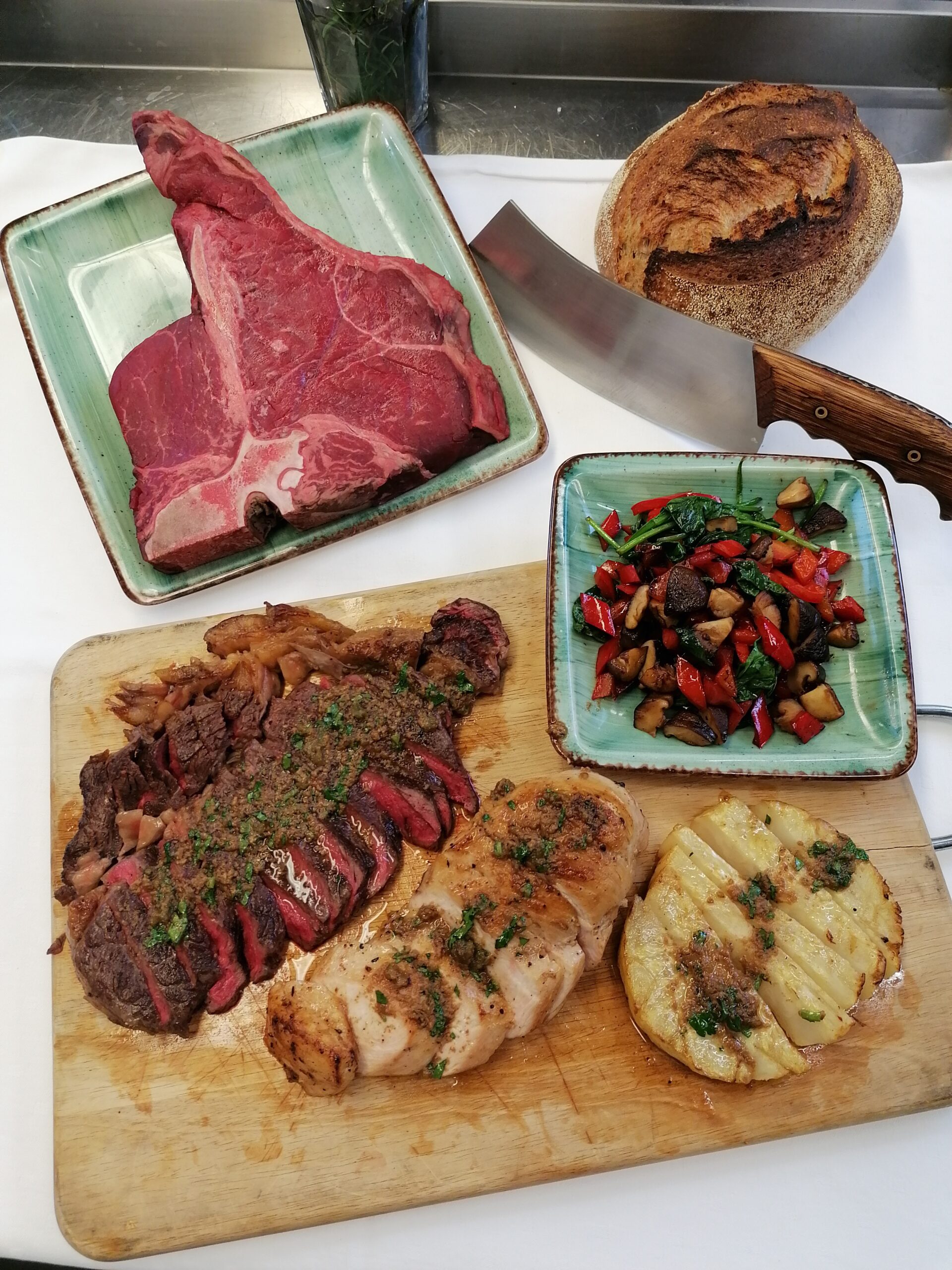
Steak variations with sautéed shiitake, kápia pepper, baby spinach, and butter sauce
Recommended ingredient quantities for 4 servings:
Seasoned salt for the meats:
Spice blend: large grain sea salt, smoked whole peppercorns, dried tomatoes and peppers, garlic, rosemary
For the beef steak:
600 g boneless aged rib-eye or 1 kg aged T-bone steak
seasoned salt
olive oil, butter for frying
butter for spreading
For the chicken steak:
300 g free-range chicken breast fillet
seasoned salt
olive oil, butter for frying
butter for spreading
For the celery steak:
200 g celery root
seasoned salt (curry, turmeric, smoked paprika, garlic)
olive oil for frying
butter for spreading
For the sautéed shiitake mushrooms:
120 g shiitake
olive oil
ginger
soy sauce
120 g kápia pepper
100 g baby spinach
parsley
For the butter sauce:
butter
mustard
soy sauce
wasabi
lemon juice
Preparation steps:
- Grind the salt and pepper in a mortar and mix with the other seasonings.
- Rub the prepared meats with the seasoned salt.
- First, sear the meats in a little oil in a hot pan to form a crust, then continue cooking them while basting with butter.
- Place the meats on a rack in a baking tray, brush them with butter, then heat-treat the beef for 12 minutes and the chicken for 20 minutes in a 70-degree Celsius oven.
- Blanch the prepared celery slices in seasoned salted water, dry them with paper towel, sauté briefly in a little hot oil, then place on a rack, brush with butter, and finally heat-treat in a 70-degree oven for 10 minutes.
- For the ragout, sauté the shiitake mushrooms in a little oil, add the diced kápia peppers, then toss everything with baby spinach and finely chopped parsley.
- Prepare the sauce in the pan used for frying by adding butter, mustard, soy sauce, and wasabi, then adjust the final flavor with lemon juice.
- For serving, slice the rested meats (rested for 10–12 minutes) diagonally across the grain and arrange them on a wooden platter, place the celery slices beside them, and drizzle with the buttery sauce combined with the meat juices from the baking tray. Serve the sautéed vegetables separately in a bowl.
*
Preview
Gaining experience in more developed countries 1993-2004.
Joyful cooking with György László, with whom we worked together on the juries of domestic and international chef competitions from the 1990s.
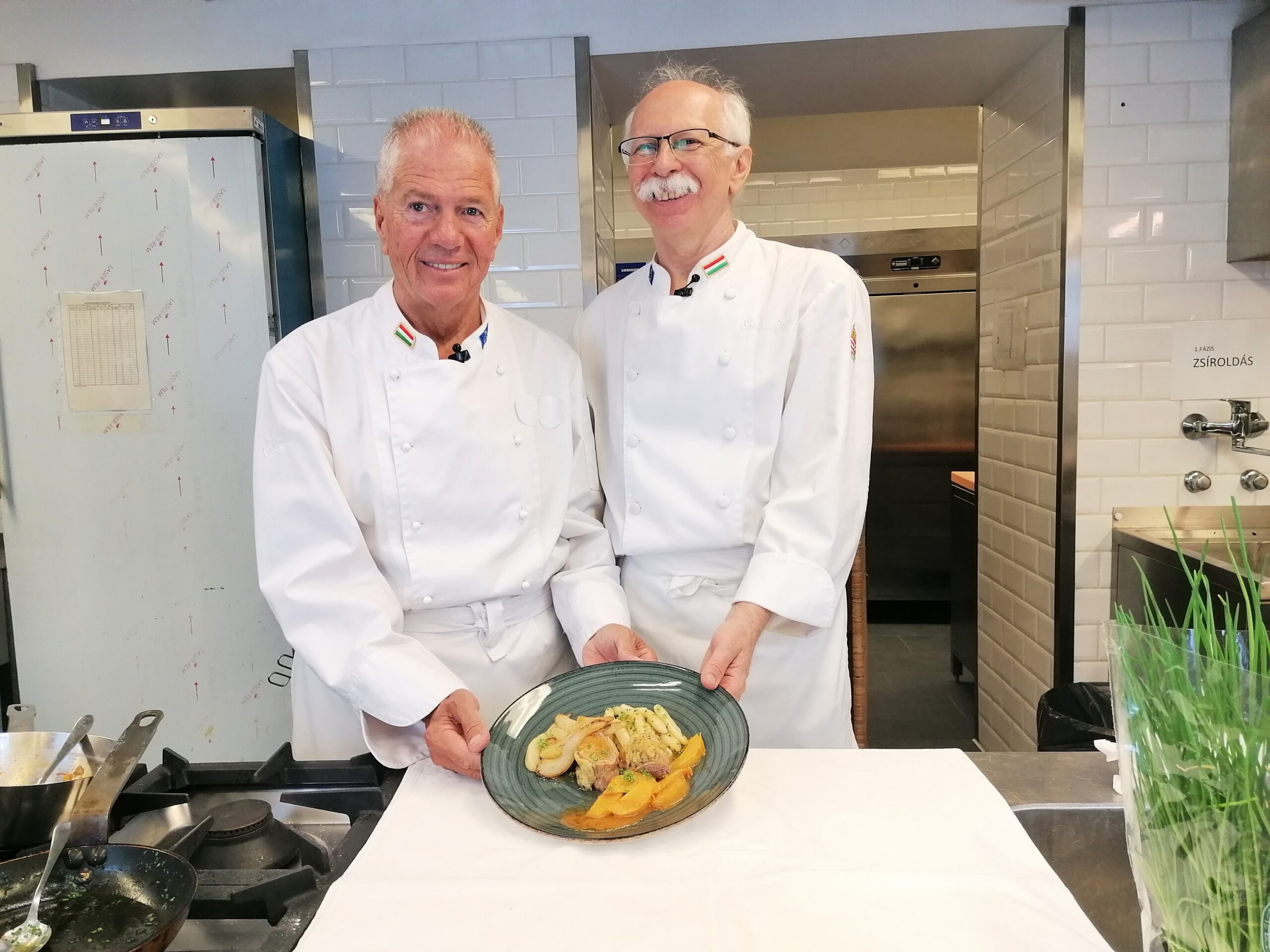
With Gyuri László
*